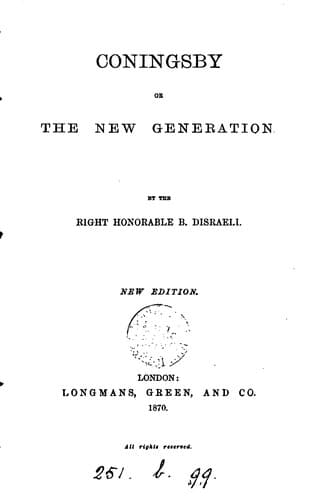
Coningsby; Or, The New GenerationDisraeli, Benjamin, Earl of Beaconsfield
General
Coningsby; Or, The New Generation
Disraeli, Benjamin, Earl of Beaconsfield
Great Britain -- Fiction; Political fiction; Politicians -- Fiction
And yet, perhaps, he might have been coddled into a prig, or flattered
into a profligate, had it not been for the intervening experience which
he had gained between his school and college life. That had visibly
impressed upon him, what before he had only faintly acquired from books,
that there was a greater and more real world awaiting him, than to be
found in those bowers of Academus to which youth is apt at first to
attribute an exaggerated importance. A world of action and passion,
of power and peril; a world for which a great preparation was indeed
necessary, severe and profound, but not altogether such an one as was
now offered to him. Yet this want must be supplied, and by himself.
Coningsby had already acquirements sufficiently considerable, with some
formal application, to ensure him at all times his degree. He was no
longer engrossed by the intention he once proudly entertained of trying
for honours, and he chalked out for himself that range of reading,
which, digested by his thought, should furnish him in some degree with
that various knowledge of the history of man to which he aspired. No, we
must not for a moment believe that accident could have long diverted
the course of a character so strong. The same desire that prevented the
Castle of his grandfather from proving a Castle of Indolence to
him, that saved him from a too early initiation into the seductive
distractions of a refined and luxurious society, would have preserved
Coningsby from the puerile profligacy of a college life, or from being
that idol of private tutors, a young pedant. It was that noble ambition,
the highest and the best, that must be born in the heart and organised
in the brain, which will not let a man be content, unless his
intellectual power is recognised by his race, and desires that it should
contribute to their welfare. It is the heroic feeling; the feeling that
in old days produced demigods; without which no State is safe; without
which political institutions are meat without salt; the Crown a
bauble, the Church an establishment, Parliaments debating-clubs, and
Civilisation itself but a fitful and transient dream.
CHAPTER II.
Less than a year after the arrival of Coningsby at Cambridge, and which
he had only once quitted in the interval, and that to pass a short
time in Berkshire with his friend Buckhurst, occurred the death of
King William IV. This event necessarily induced a dissolution of the
Parliament, elected under the auspices of Sir Robert Peel in 1834, and
after the publication of the Tamworth Manifesto.
Public-domain text, read in full here on John Shaqi.
Reviews
Reviews
No reviews yet
Be the first to share your thoughts on this work.
Elsewhere in the archive
Join the Discussion
Join the discussion
Sign in to leave a comment or review.
Sign InorCreate an account