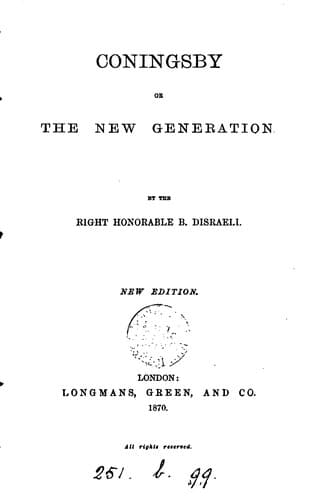
Coningsby; Or, The New GenerationDisraeli, Benjamin, Earl of Beaconsfield
General
Coningsby; Or, The New Generation
Disraeli, Benjamin, Earl of Beaconsfield
Great Britain -- Fiction; Political fiction; Politicians -- Fiction
The twelve-hundred-a-yearers were in despair about the King’s death.
Their loyal souls were sorely grieved that his gracious Majesty had not
outlived the Registration. All their happy inventions about ‘hay-fever,’
circulated in confidence, and sent by post to chairmen of Conservative
Associations, followed by a royal funeral! General election about to
take place with the old registration; government boroughs against them,
and the young Queen for a cry. What a cry! Youth, beauty, and a Queen!
Taper grew pale at the thought. What could they possibly get up to
countervail it? Even Church and Corn-laws together would not do; and
then Church was sulky, for the Conservative Cause had just made it a
present of a commission, and all that the country gentlemen knew of
Conservatism was, that it would not repeal the Malt Tax, and had made
them repeal their pledges. Yet a cry must be found. A dissolution
without a cry, in the Taper philosophy, would be a world without a sun.
A rise might be got by ‘Independence of the House of Lords;’ and Lord
Lyndhurst’s summaries might be well circulated at one penny per hundred,
large discount allowed to Conservative Associations, and endless credit.
Tadpole, however, was never very fond of the House of Lords; besides, it
was too limited. Tadpole wanted the young Queen brought in; the rogue!
At length, one morning, Taper came up to him with a slip of paper, and a
smile of complacent austerity on his dull visage, ‘I think, Mr. Tadpole,
that will do!’
Tadpole took the paper and read, ‘OUR YOUNG QUEEN, AND OUR OLD
INSTITUTIONS.’
The eyes of Tadpole sparkled as if they had met a gnomic sentence of
Periander or Thales; then turning to Taper, he said,
‘What do you think of “ancient,” instead of “old”?’
‘You cannot have “Our modern Queen and our ancient Institutions,”’ said
Mr. Taper.
The dissolution was soon followed by an election for the borough of
Cambridge. The Conservative Cause candidate was an old Etonian. That was
a bond of sympathy which imparted zeal even to those who were a little
sceptical of the essential virtues of Conservatism. Every undergraduate
especially who remembered ‘the distant spires,’ became enthusiastic.
Buckhurst took a very decided part. He cheered, he canvassed, he brought
men to the poll whom none could move; he influenced his friends and
his companions. Even Coningsby caught the contagion, and Vere, who had
imbibed much of Coningsby’s political sentiment, prevailed on himself to
be neutral. The Conservative Cause triumphed in the person of its Eton
champion. The day the member was chaired, several men in Coningsby’s
rooms were talking over their triumph.
‘By Jove!’ said the panting Buckhurst, throwing himself on the sofa, ‘it
was well done; never was any thing better done. An immense triumph! The
greatest triumph the Conservative Cause has had. And yet,’ he added,
laughing, ‘if any fellow were to ask me what the Conservative Cause is,
I am sure I should not know what to say.’
Public-domain text, read in full here on John Shaqi.
Reviews
Reviews
No reviews yet
Be the first to share your thoughts on this work.
Elsewhere in the archive
Join the Discussion
Join the discussion
Sign in to leave a comment or review.
Sign InorCreate an account