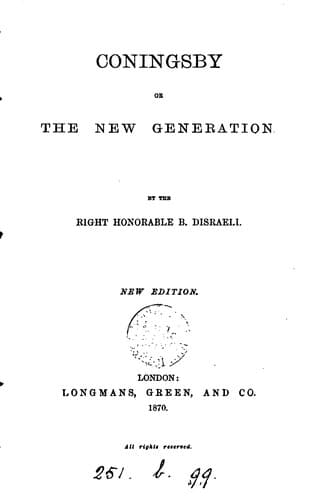
Coningsby; Or, The New GenerationDisraeli, Benjamin, Earl of Beaconsfield
General
Coningsby; Or, The New Generation
Disraeli, Benjamin, Earl of Beaconsfield
Great Britain -- Fiction; Political fiction; Politicians -- Fiction
‘I repeat it,’ said Coningsby. ‘The great object of the Whig leaders
in England from the first movement under Hampden to the last most
successful one in 1688, was to establish in England a high aristocratic
republic on the model of the Venetian, then the study and admiration of
all speculative politicians. Read Harrington; turn over Algernon
Sydney; then you will see how the minds of the English leaders in the
seventeenth century were saturated with the Venetian type. And they at
length succeeded. William III. found them out. He told the Whig leaders,
“I will not be a Doge.” He balanced parties; he baffled them as the
Puritans baffled them fifty years before. The reign of Anne was a
struggle between the Venetian and the English systems. Two great Whig
nobles, Argyle and Somerset, worthy of seats in the Council of Ten,
forced their Sovereign on her deathbed to change the ministry. They
accomplished their object. They brought in a new family on their own
terms. George I. was a Doge; George II. was a Doge; they were what
William III., a great man, would not be. George III. tried not to be
a Doge, but it was impossible materially to resist the deeply-laid
combination. He might get rid of the Whig magnificoes, but he could not
rid himself of the Venetian constitution. And a Venetian constitution
did govern England from the accession of the House of Hanover until
1832. Now I do not ask you, Vere, to relinquish the political tenets
which in ordinary times would have been your inheritance. All I say is,
the constitution introduced by your ancestors having been subverted by
their descendants your contemporaries, beware of still holding Venetian
principles of government when you have not a Venetian constitution to
govern with. Do what I am doing, what Henry Sydney and Buckhurst are
doing, what other men that I could mention are doing, hold yourself
aloof from political parties which, from the necessity of things, have
ceased to have distinctive principles, and are therefore practically
only factions; and wait and see, whether with patience, energy, honour,
and Christian faith, and a desire to look to the national welfare and
not to sectional and limited interests; whether, I say, we may not
discover some great principles to guide us, to which we may adhere, and
which then, if true, will ultimately guide and control others.’
‘The Whigs are worn out,’ said Vere, ‘Conservatism is a sham, and
Radicalism is pollution.’
‘I certainly,’ said Buckhurst, ‘when I get into the House of Commons,
shall speak my mind without reference to any party whatever; and all
I hope is, we may all come in at the same time, and then we may make a
party of our own.’
‘I have always heard my father say,’ said Vere, ‘that there was nothing
so difficult as to organise an independent party in the House of
Commons.’
‘Ay! but that was in the Venetian period, Vere,’ said Henry Sydney,
smiling.
Public-domain text, read in full here on John Shaqi.
Reviews
Reviews
No reviews yet
Be the first to share your thoughts on this work.
Elsewhere in the archive
Join the Discussion
Join the discussion
Sign in to leave a comment or review.
Sign InorCreate an account