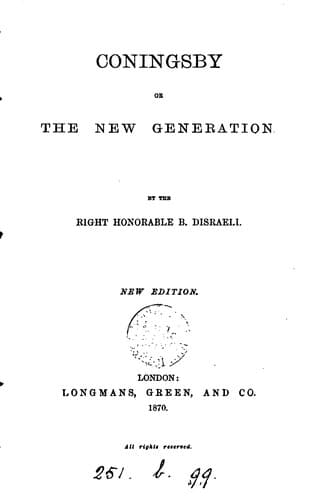
Coningsby; Or, The New GenerationDisraeli, Benjamin, Earl of Beaconsfield
General
Coningsby; Or, The New Generation
Disraeli, Benjamin, Earl of Beaconsfield
Great Britain -- Fiction; Political fiction; Politicians -- Fiction
‘Where is the spirit that raised these walls?’ thought Coningsby. ‘Is it
indeed extinct? Is then this civilisation, so much vaunted, inseparable
from moderate feelings and little thoughts? If so, give me back
barbarism! But I cannot believe it. Man that is made in the image of the
Creator, is made for God-like deeds. Come what come may, I will cling to
the heroic principle. It can alone satisfy my soul.’
CHAPTER III.
We must now revert to the family, or rather the household, of Lord
Monmouth, in which considerable changes and events had occurred since
the visit of Coningsby to the Castle in the preceding autumn.
In the first place, the earliest frost of the winter had carried off
the aged proprietor of Hellingsley, that contiguous estate which Lord
Monmouth so much coveted, the possession of which was indeed one of the
few objects of his life, and to secure which he was prepared to pay
far beyond its intrinsic value, great as that undoubtedly was. Yet Lord
Monmouth did not become its possessor. Long as his mind had been intent
upon the subject, skilful as had been his combinations to secure his
prey, and unlimited the means which were to achieve his purpose, another
stepped in, and without his privity, without even the consolation of a
struggle, stole away the prize; and this too a man whom he hated, almost
the only individual out of his own family that he did hate; a man who
had crossed him before in similar enterprises; who was his avowed foe;
had lavished treasure to oppose him in elections; raised associations
against his interest; established journals to assail him; denounced him
in public; agitated against him in private; had declared more than
once that he would make ‘the county too hot for him;’ his personal,
inveterate, indomitable foe, Mr. Millbank of Millbank.
The loss of Hellingsley was a bitter disappointment to Lord Monmouth;
but the loss of it to such an adversary touched him to the quick. He did
not seek to control his anger; he could not succeed even in concealing
his agitation. He threw upon Rigby that glance so rare with him, but
under which men always quailed; that play of the eye which Lord Monmouth
shared in common with Henry VIII., that struck awe into the trembling
Commons when they had given an obnoxious vote, as the King entered the
gallery of his palace, and looked around him.
It was a look which implied that dreadful question, ‘Why have I bought
you that such things should happen? Why have I unlimited means and
unscrupulous agents?’ It made Rigby even feel; even his brazen tones
were hushed.
Public-domain text, read in full here on John Shaqi.
Reviews
Reviews
No reviews yet
Be the first to share your thoughts on this work.
Elsewhere in the archive
Join the Discussion
Join the discussion
Sign in to leave a comment or review.
Sign InorCreate an account