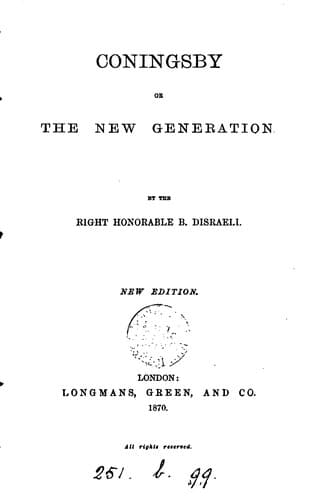
Coningsby; Or, The New GenerationDisraeli, Benjamin, Earl of Beaconsfield
General
Coningsby; Or, The New Generation
Disraeli, Benjamin, Earl of Beaconsfield
Great Britain -- Fiction; Political fiction; Politicians -- Fiction
When Lord Monmouth had fixed his wedding-day he had written himself
to Coningsby to announce his intended marriage, and to request his
grandson’s presence at the ceremony. The letter was more than kind; it
was warm and generous. He assured his grandson that this alliance
should make no difference in the very ample provision which he had
long intended for him; that he should ever esteem Coningsby his
nearest relative; and that, while his death would bring to Coningsby as
considerable an independence as an English gentleman need desire, so
in his lifetime Coningsby should ever be supported as became his birth,
breeding, and future prospects. Lord Monmouth had mentioned to Lucretia,
that he was about to invite his grandson to their wedding, and the lady
had received the intimation with satisfaction. It so happened that a
few hours after, Lucretia, who now entered the private rooms of Lord
Monmouth without previously announcing her arrival, met Villebecque with
the letter to Coningsby in his hand. Lucretia took it away from him,
and said it should be posted with her own letters. It never reached its
destination. Our friend learnt the marriage from the newspapers, which
somewhat astounded him; but Coningsby was fond of his grandfather, and
he wrote Lord Monmouth a letter of congratulation, full of feeling and
ingenuousness, and which, while it much pleased the person to whom it
was addressed, unintentionally convinced him that Coningsby had never
received his original communication. Lord Monmouth spoke to Villebecque,
who could throw sufficient light upon the subject, but it was never
mentioned to Lady Monmouth. The Marquess was a man who always found out
everything, and enjoyed the secret.
Rather more than a year after the marriage, when Coningsby had completed
his twenty-first year, the year which he had passed so quietly at
Cambridge, he received a letter from his grandfather, informing him that
after a variety of movements Lady Monmouth and himself were established
in Paris for the season, and desiring that he would not fail to come
over as soon as practicable, and pay them as long a visit as the
regulations of the University would permit. So, at the close of the
December term, Coningsby quitted Cambridge for Paris.
Public-domain text, read in full here on John Shaqi.
Reviews
Reviews
No reviews yet
Be the first to share your thoughts on this work.
Elsewhere in the archive
Join the Discussion
Join the discussion
Sign in to leave a comment or review.
Sign InorCreate an account