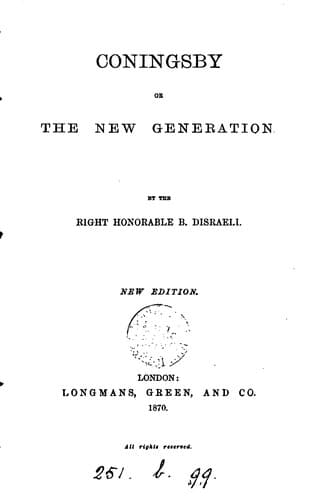
Coningsby; Or, The New GenerationDisraeli, Benjamin, Earl of Beaconsfield
General
Coningsby; Or, The New Generation
Disraeli, Benjamin, Earl of Beaconsfield
Great Britain -- Fiction; Political fiction; Politicians -- Fiction
‘I suspect the reverse,’ replied Sidonia. ‘The tendency of advanced
civilisation is in truth to pure Monarchy. Monarchy is indeed a
government which requires a high degree of civilisation for its full
development. It needs the support of free laws and manners, and of
a widely-diffused intelligence. Political compromises are not to be
tolerated except at periods of rude transition. An educated nation
recoils from the imperfect vicariate of what is called a representative
government. Your House of Commons, that has absorbed all other powers
in the State, will in all probability fall more rapidly than it rose.
Public opinion has a more direct, a more comprehensive, a more efficient
organ for its utterance, than a body of men sectionally chosen. The
Printing-press is a political element unknown to classic or feudal
times. It absorbs in a great degree the duties of the Sovereign, the
Priest, the Parliament; it controls, it educates, it discusses. That
public opinion, when it acts, would appear in the form of one who has no
class interests. In an enlightened age the Monarch on the throne, free
from the vulgar prejudices and the corrupt interests of the subject,
becomes again divine!’
At this moment they reached that part of the Boulevards which leads into
the Place of the Madeleine, whither Sidonia was bound; and Coningsby was
about to quit his companion, when Sidonia said:
‘I am only going a step over to the Rue Tronchet to say a few words to a
friend of mine, M. P----s. I shall not detain you five minutes; and you
should know him, for he has some capital pictures, and a collection of
Limoges ware that is the despair of the dilettanti.’
So saying they turned down by the Place of the Madeleine, and soon
entered the court of the hotel of M. P----s. That gentleman received
them in his gallery. After some general conversation, Coningsby turned
towards the pictures, and left Sidonia with their host. The collection
was rare, and interested Coningsby, though unacquainted with art. He
sauntered on from picture to picture until he reached the end of the
gallery, where an open door invited him into a suite of rooms also
full of pictures and objects of curiosity and art. As he was entering
a second chamber, he observed a lady leaning back in a cushioned
chair, and looking earnestly on a picture. His entrance was unheard and
unnoticed, for the lady’s back was to the door; yet Coningsby, advancing
in an angular direction, obtained nearly a complete view of her
countenance. It was upraised, gazing on the picture with an expression
of delight; the bonnet thrown back, while the large sable cloak of the
gazer had fallen partly off. The countenance was more beautiful than the
beautiful picture. Those glowing shades of the gallery to which love,
and genius, and devotion had lent their inspiration, seemed without
life and lustre by the radiant expression and expressive presence which
Coningsby now beheld.
Public-domain text, read in full here on John Shaqi.
Reviews
Reviews
No reviews yet
Be the first to share your thoughts on this work.
Elsewhere in the archive
Join the Discussion
Join the discussion
Sign in to leave a comment or review.
Sign InorCreate an account