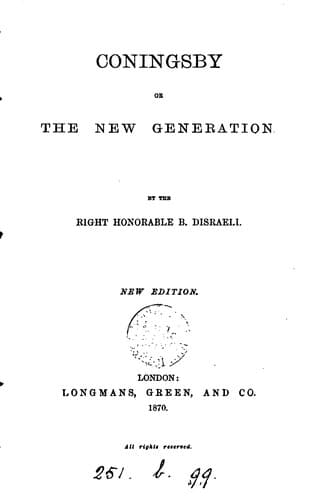
Coningsby; Or, The New GenerationDisraeli, Benjamin, Earl of Beaconsfield
General
Coningsby; Or, The New Generation
Disraeli, Benjamin, Earl of Beaconsfield
Great Britain -- Fiction; Political fiction; Politicians -- Fiction
Lord Monmouth’s dinners at Paris were celebrated. It was generally
agreed that they had no rivals; yet there were others who had as skilful
cooks, others who, for such a purpose, were equally profuse in their
expenditure. What, then, was the secret spell of his success? The
simplest in the world, though no one seemed aware of it. His Lordship’s
plates were always hot: whereas at Paris, in the best appointed houses,
and at dinners which, for costly materials and admirable art in their
preparation, cannot be surpassed, the effect is always considerably
lessened, and by a mode the most mortifying: by the mere circumstance
that every one at a French dinner is served on a cold plate. The reason
of a custom, or rather a necessity, which one would think a nation so
celebrated for their gastronomical taste would recoil from, is really,
it is believed, that the ordinary French porcelain is so very inferior
that it cannot endure the preparatory heat for dinner. The common white
pottery, for example, which is in general use, and always found at the
cafés, will not bear vicinage to a brisk kitchen fire for half-an-hour.
Now, if we only had that treaty of commerce with France which has been
so often on the point of completion, the fabrics of our unrivalled
potteries, in exchange for their capital wines, would be found
throughout France. The dinners of both nations would be improved: the
English would gain a delightful beverage, and the French, for the first
time in their lives, would dine off hot plates. An unanswerable instance
of the advantages of commercial reciprocity.
The guests at Lord Monmouth’s to-day were chiefly Carlists, individuals
bearing illustrious names, that animate the page of history, and are
indissolubly bound up with the glorious annals of their great country.
They are the phantoms of a past, but real Aristocracy; an Aristocracy
that was founded on an intelligible principle; which claimed great
privileges for great purposes; whose hereditary duties were such, that
their possessors were perpetually in the eye of the nation, and
who maintained, and, in a certain point of view justified, their
pre-eminence by constant illustration.
Public-domain text, read in full here on John Shaqi.
Reviews
Reviews
No reviews yet
Be the first to share your thoughts on this work.
Elsewhere in the archive
Join the Discussion
Join the discussion
Sign in to leave a comment or review.
Sign InorCreate an account