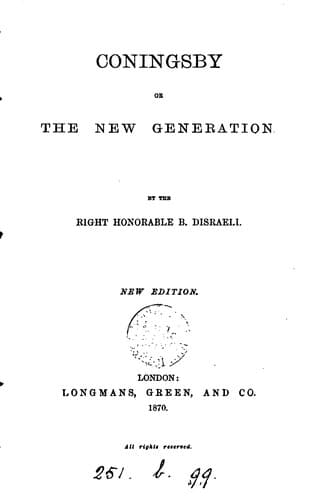
Coningsby; Or, The New GenerationDisraeli, Benjamin, Earl of Beaconsfield
General
Coningsby; Or, The New Generation
Disraeli, Benjamin, Earl of Beaconsfield
Great Britain -- Fiction; Political fiction; Politicians -- Fiction
Coningsby, who had stolen away from his grandfather’s before the rest of
the guests, was delighted with the novelty of the splendid scene. He had
been in Paris long enough to make some acquaintances, and mostly with
celebrated personages. In his long fruitless endeavour to enter the
saloon in which they danced, he found himself hustled against the
illustrious Baron von H----t, whom he had sat next to at dinner a few
days before at Count M----é’s.
‘It is more difficult than cutting through the Isthmus of Panama,
Baron,’ said Coningsby, alluding to a past conversation.
‘Infinitely,’ replied M. de H., smiling; ‘for I would undertake to
cut through the Isthmus, and I cannot engage that I shall enter this
ball-room.’
Time, however, brought Coningsby into that brilliant chamber. What a
blaze of light and loveliness! How coquettish are the costumes! How
vivid the flowers! To sounds of stirring melody, beautiful beings move
with grace. Grace, indeed, is beauty in action.
Here, where all are fair and everything is attractive, his eye is
suddenly arrested by one object, a form of surpassing grace among the
graceful, among the beauteous a countenance of unrivalled beauty.
She was young among the youthful; a face of sunshine amid all that
artificial light; her head placed upon her finely-moulded shoulders with
a queen-like grace; a coronet of white roses on her dark brown hair; her
only ornament. It was the beauty of the picture-gallery.
The eye of Coningsby never quitted her. When the dance ceased, he had an
opportunity of seeing her nearer. He met her walking with her cavalier,
and he was conscious that she observed him. Finally he remarked that she
resumed a seat next to the lady whom he had mistaken for her mother, but
had afterwards understood to be Lady Wallinger.
Coningsby returned to the other saloons: he witnessed the entrance and
reception of Lady Monmouth, who moved on towards the ball-room. Soon
after this, Sidonia arrived; he came in with the still handsome and ever
courteous Duke D----s. Observing Coningsby, he stopped to present him to
the Duke. While thus conversing, the Duke, who is fond of the English,
observed, ‘See, here is your beautiful countrywoman that all the world
are talking of. That is her uncle. He brings to me letters from one of
your lords, whose name I cannot recollect.’
And Sir Joseph and his lovely niece veritably approached. The Duke
addressed them: asked them in the name of his Duchess to a concert on
the next Thursday; and, after a thousand compliments, moved on. Sidonia
stopped; Coningsby could not refrain from lingering, but stood a little
apart, and was about to move away, when there was a whisper, of which,
without hearing a word, he could not resist the impression that he was
the subject. He felt a little embarrassed, and was retiring, when he
heard Sidonia reply to an inquiry of the lady, ‘The same,’ and then,
turning to Coningsby, said aloud, ‘Coningsby, Miss Millbank says that
you have forgotten her.’
Public-domain text, read in full here on John Shaqi.
Reviews
Reviews
No reviews yet
Be the first to share your thoughts on this work.
Elsewhere in the archive
Join the Discussion
Join the discussion
Sign in to leave a comment or review.
Sign InorCreate an account