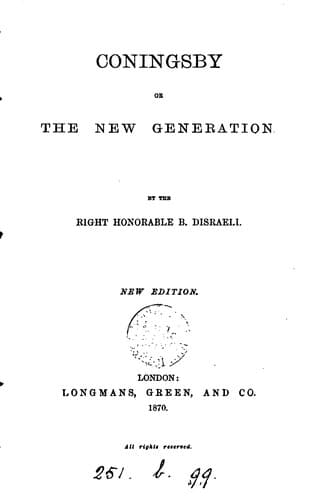
Coningsby; Or, The New GenerationDisraeli, Benjamin, Earl of Beaconsfield
General
Coningsby; Or, The New Generation
Disraeli, Benjamin, Earl of Beaconsfield
Great Britain -- Fiction; Political fiction; Politicians -- Fiction
Coningsby was very happy. His morning visits to the Rue de Rivoli seemed
always welcome, and seldom an evening elapsed in which he did not find
himself in the society of Edith. She seemed not to wish to conceal that
his presence gave her pleasure, and though she had many admirers, and
had an airy graciousness for all of them, Coningsby sometimes indulged
the exquisite suspicion that there was a flattering distinction in her
carriage to himself. Under the influence of these feelings, he began
daily to be more conscious that separation would be an intolerable
calamity; he began to meditate upon the feasibility of keeping a half
term, and of postponing his departure to Cambridge to a period nearer
the time when Edith would probably return to England.
In the meanwhile, the Parisian world talked much of the grand fete which
was about to be given by Sidonia. Coningsby heard much of it one day
when dining at his grandfather’s. Lady Monmouth seemed very intent on
the occasion. Even Lord Monmouth half talked of going, though, for his
part, he wished people would come to him, and never ask him to their
houses. That was his idea of society. He liked the world, but he liked
to find it under his own roof. He grudged them nothing, so that they
would not insist upon the reciprocity of cold-catching, and would eat
his good dinners instead of insisting on his eating their bad ones.
‘But Monsieur Sidonia’s cook is a gem, they say,’ observed an Attaché of
an embassy.
‘I have no doubt of it; Sidonia is a man of sense, almost the only man
of sense I know. I never caught him tripping. He never makes a false
move. Sidonia is exactly the sort of man I like; you know you cannot
deceive him, and that he does not want to deceive you. I wish he liked a
rubber more. Then he would be perfect.’
‘They say he is going to be married,’ said the Attaché.
‘Poh!’ said Lord Monmouth.
‘Married!’ exclaimed Lady Monmouth. ‘To whom?’
‘To your beautiful countrywoman, “la belle Anglaise,” that all the world
talks of,’ said the Attaché.
‘And who may she be, pray?’ said the Marquess. ‘I have so many beautiful
countrywomen.’
‘Mademoiselle Millbank,’ said the Attaché.
‘Millbank!’ said the Marquess, with a lowering brow. ‘There are so many
Millbanks. Do you know what Millbank this is, Harry?’ he inquired of his
grandson, who had listened to the conversation with a rather embarrassed
and even agitated spirit.
‘What, sir; yes, Millbank?’ said Coningsby.
‘I say, do you know who this Millbank is?’
‘Oh! Miss Millbank: yes, I believe, that is, I know a daughter of the
gentleman who purchased some property near you.’
‘Oh! that fellow! Has he got a daughter here?’
‘The most beautiful girl in Paris,’ said the Attaché.
‘Lady Monmouth, have you seen this beauty, that Sidonia is going to
marry?’ he added, with a fiendish laugh.
‘I have seen the young lady,’ said Lady Monmouth; ‘but I had not heard
that Monsieur Sidonia was about to marry her.’
Public-domain text, read in full here on John Shaqi.
Reviews
Reviews
No reviews yet
Be the first to share your thoughts on this work.
Elsewhere in the archive
Join the Discussion
Join the discussion
Sign in to leave a comment or review.
Sign InorCreate an account