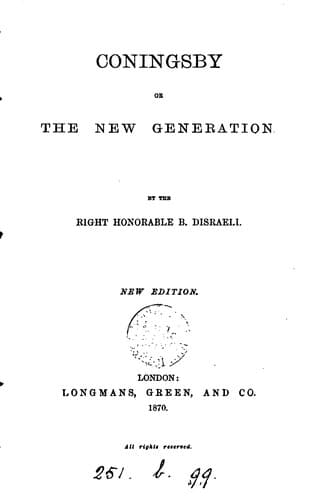
Coningsby; Or, The New GenerationDisraeli, Benjamin, Earl of Beaconsfield
General
Coningsby; Or, The New Generation
Disraeli, Benjamin, Earl of Beaconsfield
Great Britain -- Fiction; Political fiction; Politicians -- Fiction
Lord Monmouth caught the name of Millbank, and received the intimation
of Hellingsley? It was a glance for a Spagnoletto or a Caravaggio to
catch and immortalise. Why, if Edith were not going to marry Sidonia,
how was he ever to marry her, even if she cared for him? Oh! what a
future of unbroken, continuous, interminable misery awaited him! Was
there ever yet born a being with a destiny so dark and dismal? He was
the most forlorn of men, utterly wretched! He had entirely mistaken
his own character. He had no energy, no abilities, not a single eminent
quality. All was over!
CHAPTER V.
It was fated that Lady Monmouth should not be present at that ball,
the anticipation of which had occasioned her so much pleasure and some
pangs.
On the morning after that slight conversation, which had so disturbed
the souls, though unconsciously to each other, of herself and Coningsby,
the Marquess was driving Lucretia up the avenue Marigny in his phaeton.
About the centre of the avenue the horses took fright, and started off
at a wild pace. The Marquess was an experienced whip, calm, and with
exertion still very powerful. He would have soon mastered the horses,
had not one of the reins unhappily broken. The horses swerved; the
Marquess kept his seat; Lucretia, alarmed, sprang up, the carriage was
dashed against the trunk of a tree, and she was thrown out of it, at
the very instant that one of the outriders had succeeded in heading the
equipage and checking the horses.
The Marchioness was senseless. Lord Monmouth had descended from the
phaeton; several passengers had assembled; the door of a contiguous
house was opened; there were offers of service, sympathy, inquiries, a
babble of tongues, great confusion.
‘Get surgeons and send for her maid,’ said Lord Monmouth to one of his
servants.
In the midst of this distressing tumult, Sidonia, on horseback, followed
by a groom, came up the avenue from the Champs Elysées. The empty
phaeton, reins broken, horses held by strangers, all the appearances of
a misadventure, attracted him. He recognised the livery. He instantly
dismounted. Moving aside the crowd, he perceived Lady Monmouth senseless
and prostrate, and her husband, without assistance, restraining the
injudicious efforts of the bystanders.
‘Let us carry her in, Lord Monmouth,’ said Sidonia, exchanging a
recognition as he took Lucretia in his arms, and bore her into the
dwelling that was at hand. Those who were standing at the door assisted
him. The woman of the house and Lord Monmouth only were present.
‘I would hope there is no fracture,’ said Sidonia, placing her on a
sofa, ‘nor does it appear to me that the percussion of the head, though
considerable, could have been fatally violent. I have caught her pulse.
Keep her in a horizontal position, and she will soon come to herself.’
Public-domain text, read in full here on John Shaqi.
Reviews
Reviews
No reviews yet
Be the first to share your thoughts on this work.
Elsewhere in the archive
Join the Discussion
Join the discussion
Sign in to leave a comment or review.
Sign InorCreate an account