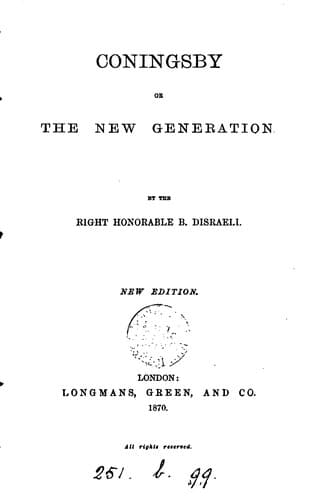
Coningsby; Or, The New GenerationDisraeli, Benjamin, Earl of Beaconsfield
General
Coningsby; Or, The New Generation
Disraeli, Benjamin, Earl of Beaconsfield
Great Britain -- Fiction; Political fiction; Politicians -- Fiction
‘And you are not going to Astrachan to-morrow?’ said Edith.
‘Not to-morrow,’ said Coningsby.
‘You know that you said once that life was too stirring in these days to
permit travel to a man?’
‘I wish nothing was stirring,’ said Coningsby. ‘I wish nothing to
change. All that I wish is, that this fête should never end.’
‘Is it possible that you can be capricious? You perplex me very much.’
‘Am I capricious because I dislike change?’
‘But Astrachan?’
‘It was the air of the Luxembourg that reminded me of the Desert,’ said
Coningsby.
Soon after this Coningsby led Edith to the dance. It was at a ball that
he had first met her at Paris, and this led to other reminiscences;
all most interesting. Coningsby was perfectly happy. All mysteries, all
difficulties, were driven from his recollection; he lived only in the
exciting and enjoyable present. Twenty-one and in love!
Some time after this, Coningsby, who was inevitably separated from
Edith, met his host.
‘Where have you been, child,’ said Sidonia, ‘that I have not seen you
for some days? I am going to Madrid tomorrow.’
‘And I must think, I suppose, of Cambridge.’
‘Well, you have seen something; you will find it more profitable when
you have digested it: and you will have opportunity. That’s the true
spring of wisdom: meditate over the past. Adventure and Contemplation
share our being like day and night.’
The resolute departure for England on the morrow had already changed
into a supposed necessity of thinking of returning to Cambridge. In
fact, Coningsby felt that to quit Paris and Edith was an impossibility.
He silenced the remonstrance of his conscience by the expedient of
keeping a half-term, and had no difficulty in persuading himself that
a short delay in taking his degree could not really be of the slightest
consequence.
It was the hour for supper. The guests at a French ball are not seen to
advantage at this period. The custom of separating the sexes for this
refreshment, and arranging that the ladies should partake of it by
themselves, though originally founded in a feeling of consideration
and gallantry, and with the determination to secure, under all
circumstances, the convenience and comfort of the fair sex, is really,
in its appearance and its consequences, anything but European, and
produces a scene which rather reminds one of the harem of a sultan than
a hall of chivalry. To judge from the countenances of the favoured fair,
they are not themselves particularly pleased; and when their repast is
over they necessarily return to empty halls, and are deprived of the
dance at the very moment when they may feel most inclined to participate
in its graceful excitement.
Public-domain text, read in full here on John Shaqi.
Reviews
Reviews
No reviews yet
Be the first to share your thoughts on this work.
Elsewhere in the archive
Join the Discussion
Join the discussion
Sign in to leave a comment or review.
Sign InorCreate an account