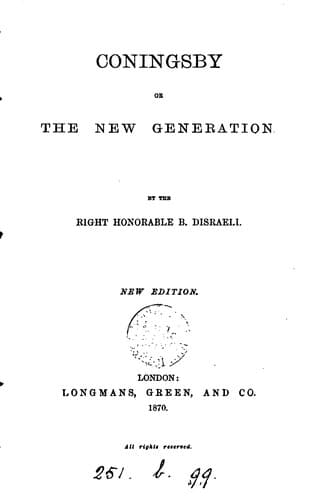
Coningsby; Or, The New GenerationDisraeli, Benjamin, Earl of Beaconsfield
General
Coningsby; Or, The New Generation
Disraeli, Benjamin, Earl of Beaconsfield
Great Britain -- Fiction; Political fiction; Politicians -- Fiction
And here we must for a moment revert to what had occurred to Coningsby
since he so suddenly quitted Paris at the beginning of the year. The
wound he had received was deep to one unused to wounds. Yet, after all,
none had outraged his feelings, no one had betrayed his hopes. He had
loved one who had loved another. Misery, but scarcely humiliation. And
yet ‘tis a bitter pang under any circumstances to find another preferred
to yourself. It is about the same blow as one would probably feel if
falling from a balloon. Your Icarian flight melts into a grovelling
existence, scarcely superior to that of a sponge or a coral, or redeemed
only from utter insensibility by your frank detestation of your rival.
It is quite impossible to conceal that Coningsby had imbibed for Sidonia
a certain degree of aversion, which, in these days of exaggerated
phrase, might even be described as hatred. And Edith was so beautiful!
And there had seemed between them a sympathy so native and spontaneous,
creating at once the charm of intimacy without any of the disenchanting
attributes that are occasionally its consequence. He would recall the
tones of her voice, the expression of her soft dark eye, the airy spirit
and frank graciousness, sometimes even the flattering blush, with which
she had ever welcomed one of whom she had heard so long and so kindly.
It seemed, to use a sweet and homely phrase, that they were made for
each other; the circumstances of their mutual destinies might have
combined into one enchanting fate.
And yet, had she accorded him that peerless boon, her heart, with what
aspect was he to communicate this consummation of all his hopes to his
grandfather, ask Lord Monmouth for his blessing, and the gracious favour
of an establishment for the daughter of his foe, of a man whose name was
never mentioned except to cloud his visage? Ah! what was that mystery
that connected the haughty house of Coningsby with the humble blood of
the Lancashire manufacturer? Why was the portrait of his mother beneath
the roof of Millbank? Coningsby had delicately touched upon the subject
both with Edith and the Wallingers, but the result of his inquiries
only involved the question in deeper gloom. Edith had none but maternal
relatives: more than once she had mentioned this, and the Wallingers, on
other occasions, had confirmed the remark. Coningsby had sometimes drawn
the conversation to pictures, and he would remind her with playfulness
of their first unconscious meeting in the gallery of the Rue Tronchet;
then he remembered that Mr. Millbank was fond of pictures; then he
recollected some specimens of Mr. Millbank’s collection, and after
touching on several which could not excite suspicion, he came to
‘a portrait, a portrait of a lady; was it a portrait or an ideal
countenance?’
Edith thought she had heard it was a portrait, but she was by no means
certain, and most assuredly was quite unacquainted with the name of the
original, if there were an original.
Public-domain text, read in full here on John Shaqi.
Reviews
Reviews
No reviews yet
Be the first to share your thoughts on this work.
Elsewhere in the archive
Join the Discussion
Join the discussion
Sign in to leave a comment or review.
Sign InorCreate an account