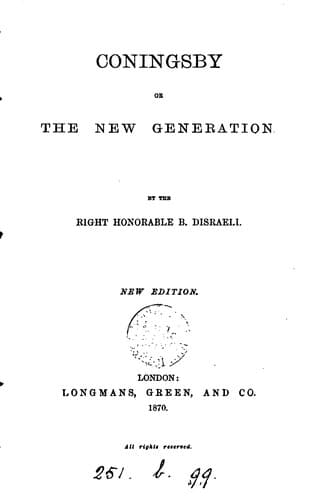
Coningsby; Or, The New GenerationDisraeli, Benjamin, Earl of Beaconsfield
General
Coningsby; Or, The New Generation
Disraeli, Benjamin, Earl of Beaconsfield
Great Britain -- Fiction; Political fiction; Politicians -- Fiction
It was Commencement, and coming out of the quadrangle of St. John’s,
Coningsby came suddenly upon Sir Joseph and Lady Wallinger, who were
visiting the marvels and rarities of the university. They were alone.
Coningsby was a little embarrassed, for he could not forget the abrupt
manner in which he had parted from them; but they greeted him with
so much cordiality that he instantly recovered himself, and, turning,
became their companion. He hardly ventured to ask after Edith: at
length, in a depressed tone and a hesitating manner, he inquired whether
they had lately seen Miss Millbank. He was himself surprised at the
extreme light-heartedness which came over him the moment he heard she
was in England, at Millbank, with her family. He always very much liked
Lady Wallinger, but this morning he hung over her like a lover, lavished
on her unceasing and the most delicate attentions, seemed to exist only
in the idea of making the Wallingers enjoy and understand Cambridge;
and no one else was to be their guide at any place or under any
circumstances. He told them exactly what they were to see; how they were
to see it; when they were to see it. He told them of things which nobody
did see, but which they should. He insisted that Sir Joseph should dine
with him in hall; Sir Joseph could not think of leaving Lady Wallinger;
Lady Wallinger could not think of Sir Joseph missing an opportunity that
might never offer again. Besides, they might both join her after dinner.
Except to give her husband a dinner, Coningsby evidently intended never
to leave her side.
And the next morning, the occasion favourable, being alone with the
lady, Sir Joseph bustling about a carriage, Coningsby said suddenly,
with a countenance a little disturbed, and in a low voice, ‘I was
pleased, I mean surprised, to hear that there was still a Miss Millbank;
I thought by this time she might have borne another name?’
Lady Wallinger looked at him with an expression of some perplexity, and
then said, ‘Yes, Edith was much admired; but she need not be precipitate
in marrying. Marriage is for a woman _the_ event. Edith is too precious
to be carelessly bestowed.’
‘But I understood,’ said Coningsby, ‘when I left Paris,’ and here, he
became very confused, ‘that Miss Millbank was engaged, on the point of
marriage.’
‘With whom?’
‘Our friend Sidonia.’
‘I am sure that Edith would never marry Monsieur de Sidonia, nor
Monsieur de Sidonia, Edith. ‘Tis a preposterous idea!’ said Lady
Wallinger.
‘But he very much admired her?’ said Coningsby with a searching eye.
‘Possibly,’ said Lady Wallinger; ‘but he never even intimated his
admiration.’
‘But he was very attentive to Miss Millbank?’
‘Not more than our intimate friendship authorised, and might expect.’
‘You have known Sidonia a long time?’
Public-domain text, read in full here on John Shaqi.
Reviews
Reviews
No reviews yet
Be the first to share your thoughts on this work.
Elsewhere in the archive
Join the Discussion
Join the discussion
Sign in to leave a comment or review.
Sign InorCreate an account