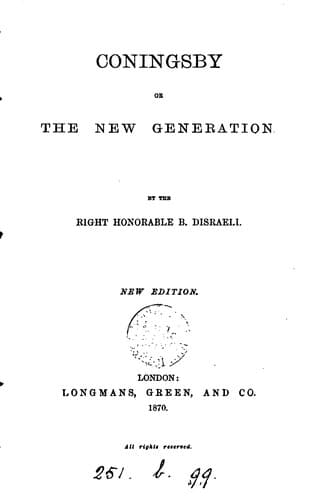
Coningsby; Or, The New GenerationDisraeli, Benjamin, Earl of Beaconsfield
General
Coningsby; Or, The New Generation
Disraeli, Benjamin, Earl of Beaconsfield
Great Britain -- Fiction; Political fiction; Politicians -- Fiction
It seemed to Coningsby that he had never been happy before. A thrilling
joy pervaded his being. He could have sung like a bird. His heart was as
sunny as the summer scene. Past and Future were absorbed in the flowing
hour; not an allusion to Paris, not a speculation on what might arrive;
but infinite expressions of agreement, sympathy; a multitude of slight
phrases, that, however couched, had but one meaning, congeniality. He
felt each moment his voice becoming more tender; his heart gushing
in soft expressions; each moment he was more fascinated; her step was
grace, her glance was beauty. Now she touched him by some phrase of
sweet simplicity; or carried him spell-bound by her airy merriment.
Oswald assumed that Coningsby remained to dine with them. There was not
even the ceremony of invitation. Coningsby could not but remember his
dinner at Millbank, and the timid hostess whom he then addressed so
often in vain, as he gazed upon the bewitching and accomplished woman
whom he now passionately loved. It was a most agreeable dinner. Oswald,
happy in his friend being his guest, under his own roof, indulged in
unwonted gaiety.
The ladies withdrew; Sir Joseph began to talk politics, although the
young men had threatened their fair companions immediately to follow
them. This was the period of the Bed-Chamber Plot, when Sir Robert Peel
accepted and resigned power in the course of three days. Sir Joseph,
who had originally made up his mind to support a Conservative government
when he deemed it inevitable, had for the last month endeavoured to
compensate for this trifling error by vindicating the conduct of his
friends, and reprobating the behaviour of those who would deprive her
Majesty of the ‘friends-of-her-youth.’ Sir Joseph was a most chivalrous
champion of the ‘friends-of-her-youth’ principle. Sir Joseph, who was
always moderate and conciliatory in his talk, though he would go, at any
time, any lengths for his party, expressed himself to-day with
extreme sobriety, as he was determined not to hurt the feelings of
Mr. Coningsby, and he principally confined himself to urging temperate
questions, somewhat in the following fashion:--
‘I admit that, on the whole, under ordinary circumstances, it would
perhaps have been more convenient that these appointments should have
remained with Sir Robert; but don’t you think that, under the peculiar
circumstances, being friends of her Majesty’s youth?’ &c. &c.
Sir Joseph was extremely astonished when Coningsby replied that he
thought, under no circumstances, should any appointment in the Royal
Household be dependent on the voice of the House of Commons, though he
was far from admiring the ‘friends-of-her-youth’ principle, which he
looked upon as impertinent.
‘But surely,’ said Sir Joseph, ‘the Minister being responsible to
Parliament, it must follow that all great offices of State should be
filled at his discretion.’
‘But where do you find this principle of Ministerial responsibility?’
inquired Coningsby.
Public-domain text, read in full here on John Shaqi.
Reviews
Reviews
No reviews yet
Be the first to share your thoughts on this work.
Elsewhere in the archive
Join the Discussion
Join the discussion
Sign in to leave a comment or review.
Sign InorCreate an account