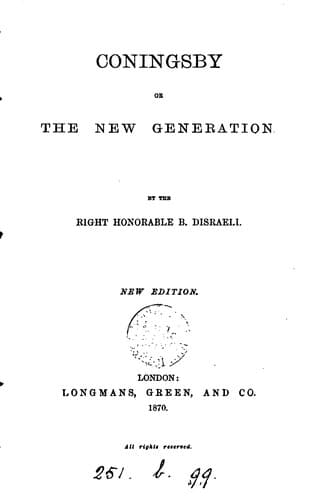
Coningsby; Or, The New GenerationDisraeli, Benjamin, Earl of Beaconsfield
General
Coningsby; Or, The New Generation
Disraeli, Benjamin, Earl of Beaconsfield
Great Britain -- Fiction; Political fiction; Politicians -- Fiction
As Edith headed her father’s table, according to his rigid rule,
Coningsby was on one side of her. They never spoke so little; Coningsby
would have never unclosed his lips, had he followed his humour. He was
in a stupor of happiness; the dining room took the appearance of
the fishing-cottage; and he saw nothing but the flowing river. Lady
Wallinger was however next to him, and that was a relief; for he felt
always she was his friend. Sir Joseph, a good-hearted man, and
on subjects with which he was acquainted full of sound sense, was
invaluable to-day, for he entirely kept up the conversation, speaking
of things which greatly interested Mr. Millbank. And so their host soon
recovered his good temper; he addressed several times his observations
to Coningsby, and was careful to take wine with him. On the whole,
affairs went on flowingly enough. The gentlemen, indeed, stayed much
longer over their wine than on the preceding days, and Coningsby did not
venture on the liberty of quitting the room before his host. It was as
well. Edith required repose. She tried to seek it on the bosom of her
aunt, as she breathed to her the delicious secret of her life. When the
gentlemen returned to the drawing-room the ladies were not there.
This rather disturbed Mr. Millbank again; he had not seen enough of his
daughter; he wished to hear her sing. But Edith managed to reappear; and
even to sing. Then Coningsby went up to her and asked her to sing the
song of the Girls of Granada. She said in a low voice, and with a fond
yet serious look,
‘I am not in the mood for such a song, but if you wish me--’
She sang it, and with inexpressible grace, and with an arch vivacity,
that to a fine observer would have singularly contrasted with the
almost solemn and even troubled expression of her countenance a moment
afterwards.
The day was about to die; the day the most important, the most precious
in the lives of Harry Coningsby and Edith Millbank. Words had been
spoken, vows breathed, which were to influence their careers for ever.
For them hereafter there was to be but one life, one destiny, one world.
Each of them was still in such a state of tremulous excitement, that
neither had found time or occasion to ponder over the mighty result.
They both required solitude; they both longed to be alone. Coningsby
rose to depart. He pressed the soft hand of Edith, and his glance spoke
his soul.
‘We shall see you at breakfast to-morrow, Coningsby!’ said Oswald,
very loud, knowing that the presence of his father would make Coningsby
hesitate about coming. Edith’s heart fluttered; but she said nothing. It
was with delight she heard her father, after a moment’s pause, say,
‘Oh! I beg we may have that pleasure.’
‘Not quite at so early an hour,’ said Coningsby; ‘but if you will permit
me, I hope to have the pleasure of hearing from you to-morrow, sir, that
your journey has not fatigued you.’
CHAPTER VII.
Public-domain text, read in full here on John Shaqi.
Reviews
Reviews
No reviews yet
Be the first to share your thoughts on this work.
Elsewhere in the archive
Join the Discussion
Join the discussion
Sign in to leave a comment or review.
Sign InorCreate an account