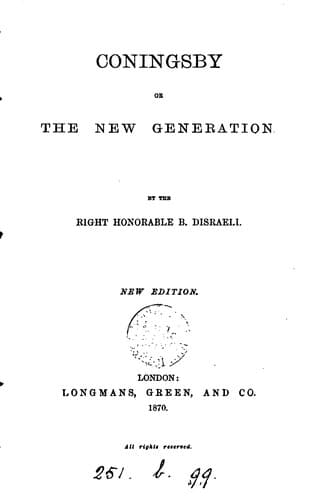
Coningsby; Or, The New GenerationDisraeli, Benjamin, Earl of Beaconsfield
General
Coningsby; Or, The New Generation
Disraeli, Benjamin, Earl of Beaconsfield
Great Britain -- Fiction; Political fiction; Politicians -- Fiction
‘It is then a mutual attachment, which, if cherished, must produce
mutual unhappiness,’ said Mr. Millbank.
‘I would fain believe the reverse,’ said Coningsby.
‘Why?’ inquired Mr. Millbank.
‘Because I believe she possesses every charm, quality, and virtue, that
can bless man; and because, though I can make her no equivalent return,
I have a heart, if I know myself, that would struggle to deserve her.’
‘I know you to be a man of sense; I believe you to be a man of honour,’
replied Mr. Millbank. ‘As the first, you must feel that an union between
you and my daughter is impossible; what then should be your duty as a
man of correct principle is obvious.’
‘I could conceive that our union might be attended with difficulties,’
said Coningsby, in a somewhat deprecating tone.
‘Sir, it is impossible,’ repeated Mr. Millbank, interrupting him, though
not with harshness; ‘that is to say, there is no conceivable marriage
which could be effected at greater sacrifices, and which would occasion
greater misery.’
‘The sacrifices are more apparent to me than the misery,’ said
Coningsby, ‘and even they may be imaginary.’
‘The sacrifices and the misery are certain and inseparable,’ said Mr.
Millbank. ‘Come now, see how we stand! I speak without reserve, for this
is a subject which cannot permit misconception, but with no feelings
towards you, sir, but fair and friendly ones. You are the grandson of
my Lord Monmouth; at present enjoying his favour, but dependent on his
bounty. You may be the heir of his wealth to-morrow, and to-morrow you
may be the object of his hatred and persecution. Your grandfather and
myself are foes; bitter, irreclaimable, to the death. It is idle to
mince phrases; I do not vindicate our mutual feelings, I may regret that
they have ever arisen; I may regret it especially at this exigency. They
are not the feelings of good Christians; they may be altogether to be
deplored and unjustifiable; but they exist, mutually exist; and have not
been confined to words. Lord Monmouth would crush me, had he the power,
like a worm; and I have curbed his proud fortunes often. Were it not
for this feeling I should not be here; I purchased this estate merely
to annoy him, as I have done a thousand other acts merely for his
discomfiture and mortification. In our long encounter I have done him
infinitely more injury than he could do me; I have been on the spot,
I am active, vigilant, the maker of my fortunes. He is an epicurean,
continually in foreign parts, obliged to leave the fulfilment of his
will to others. But, for these very reasons, his hate is more intense.
I can afford to hate him less than he hates me; I have injured him more.
Here are feelings to exist between human beings! But they do exist;
and now you are to go to this man, and ask his sanction to marry my
daughter!’
Public-domain text, read in full here on John Shaqi.
Reviews
Reviews
No reviews yet
Be the first to share your thoughts on this work.
Elsewhere in the archive
Join the Discussion
Join the discussion
Sign in to leave a comment or review.
Sign InorCreate an account