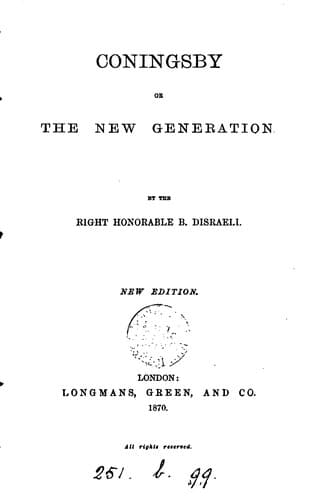
Coningsby; Or, The New GenerationDisraeli, Benjamin, Earl of Beaconsfield
General
Coningsby; Or, The New Generation
Disraeli, Benjamin, Earl of Beaconsfield
Great Britain -- Fiction; Political fiction; Politicians -- Fiction
It was the heart of the London season, nearly four years ago, twelve
months having almost elapsed since the occurrence of those painful
passages at Hellingsley which closed the last book of this history, and
long lines of carriages an hour before midnight, up the classic mount of
St. James and along Piccadilly, intimated that the world were received
at some grand entertainment in Arlington Street.
It was the town mansion of the noble family beneath whose roof at
Beaumanoir we have more than once introduced the reader, to gain whose
courtyard was at this moment the object of emulous coachmen, and to
enter whose saloons was to reward the martyr-like patience of their
lords and ladies.
Among the fortunate who had already succeeded in bowing to their hostess
were two gentlemen, who, ensconced in a good position, surveyed the
scene, and made their observations on the passing guests. They
were gentlemen who, to judge from their general air and the great
consideration with which they were treated by those who were
occasionally in their vicinity, were personages whose criticism bore
authority.
‘I say, Jemmy,’ said the eldest, a dandy who had dined with the Regent,
but who was still a dandy, and who enjoyed life almost as much as in the
days when Carlton House occupied the terrace which still bears its name.
‘I say, Jemmy, what a load of young fellows there are! Don’t know their
names at all. Begin to think fellows are younger than they used to be.
Amazing load of young fellows, indeed!’
At this moment an individual who came under the fortunate designation
of a young fellow, but whose assured carriage hardly intimated that
this was his first season in London, came up to the junior of the two
critics, and said, ‘A pretty turn you played us yesterday at White’s,
Melton. We waited dinner nearly an hour.’
‘My dear fellow, I am infinitely sorry; but I was obliged to go down to
Windsor, and I missed the return train. A good dinner? Who had you?’
‘A capital party, only you were wanted. We had Beaumanoir and Vere, and
Jack Tufton and Spraggs.’
‘Was Spraggs rich?’
‘Wasn’t he! I have not done laughing yet. He told us a story about the
little Biron who was over here last year; I knew her at Paris; and an
Indian screen. Killing! Get him to tell it you. The richest thing you
ever heard!’
‘Who’s your friend?’ inquired Mr. Melton’s companion, as the young man
moved away.
‘Sir Charles Buckhurst.’
‘A--h! That is Sir Charles Buckhurst. Glad to have seen him. They say he
is going it.’
‘He knows what he is about.’
‘Egad! so they all do. A young fellow now of two or three and twenty
knows the world as men used to do after as many years of scrapes. I
wonder where there is such a thing as a greenhorn. Effie Crabbs says
the reason he gives up his house is, that he has cleaned out the old
generation, and that the new generation would clean him.’
Public-domain text, read in full here on John Shaqi.
Reviews
Reviews
No reviews yet
Be the first to share your thoughts on this work.
Elsewhere in the archive
Join the Discussion
Join the discussion
Sign in to leave a comment or review.
Sign InorCreate an account