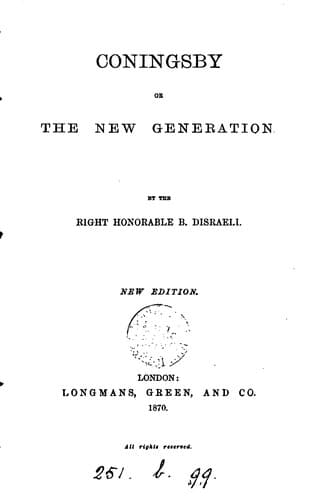
Coningsby; Or, The New GenerationDisraeli, Benjamin, Earl of Beaconsfield
General
Coningsby; Or, The New Generation
Disraeli, Benjamin, Earl of Beaconsfield
Great Britain -- Fiction; Political fiction; Politicians -- Fiction
‘Got an odd story at White’s that Lord Monmouth was going to separate
from her,’ said Mr. Cassilis.
‘No foundation,’ said Mr. Ormsby, shaking his head.
‘They are not going to separate, I believe,’ said Mr. Melton; ‘but I
rather think there was a foundation for the rumour.’
Mr. Ormsby still shook his head.
‘Well,’ continued Mr. Melton, ‘all I know is, that it was looked upon
last winter at Paris as a settled thing.’
‘There was some story about some Hungarian,’ said Mr. Cassilis.
‘No, that blew over,’ said Mr. Melton; ‘it was Trautsmansdorff the row
was about.’
All this time Mr. Ormsby, as the friend of Lord and Lady Monmouth,
remained shaking his head; but as a member of society, and therefore
delighting in small scandal, appropriating the gossip with the greatest
avidity.
‘I should think old Monmouth was not the sort of fellow to blow up a
woman,’ said Mr. Cassilis.
‘Provided she would leave him quietly,’ said Mr. Melton.
‘Yes, Lord Monmouth never could live with a woman more than two years,’
said Mr. Ormsby, pensively. ‘And that I thought at the time rather an
objection to his marriage.’
We must now briefly revert to what befell our hero after those unhappy
occurrences in the midst of whose first woe we left him.
The day after the arrival of Mr. Rigby at the Castle, Coningsby quitted
it for London, and before a week had elapsed had embarked for Cadiz. He
felt a romantic interest in visiting the land to which Edith owed some
blood, and in acquiring the language which he had often admired as she
spoke it. A favourable opportunity permitted him in the autumn to visit
Athens and the AEgean, which he much desired. In the pensive beauties
of that delicate land, where perpetual autumn seems to reign, Coningsby
found solace. There is something in the character of Grecian scenery
which blends with the humour of the melancholy and the feelings of
the sorrowful. Coningsby passed his winter at Rome. The wish of his
grandfather had rendered it necessary for him to return to England
somewhat abruptly. Lord Monmouth had not visited his native country
since his marriage; but the period that had elapsed since that event had
considerably improved the prospects of his party. The majority of the
Whig Cabinet in the House of Commons by 1840 had become little more than
nominal; and though it was circulated among their friends, as if from
the highest authority, that ‘one was enough,’ there seemed daily a
better chance of their being deprived even of that magical unit. For the
first time in the history of this country since the introduction of the
system of parliamentary sovereignty, the Government of England depended
on the fate of single elections; and indeed, by a single vote, it is
remarkable to observe, the fate of the Whig Government was ultimately
decided.
Public-domain text, read in full here on John Shaqi.
Reviews
Reviews
No reviews yet
Be the first to share your thoughts on this work.
Elsewhere in the archive
Join the Discussion
Join the discussion
Sign in to leave a comment or review.
Sign InorCreate an account