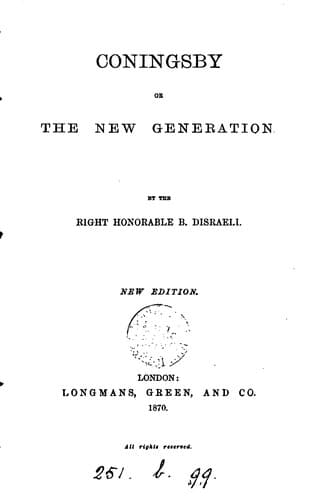
Coningsby; Or, The New GenerationDisraeli, Benjamin, Earl of Beaconsfield
General
Coningsby; Or, The New Generation
Disraeli, Benjamin, Earl of Beaconsfield
Great Britain -- Fiction; Political fiction; Politicians -- Fiction
Coningsby, as we have mentioned, had signified to Oswald his return to
England: he had hitherto omitted to write again; not because his spirit
faltered, but he was wearied of whispering hope without foundation, and
mourning over his chagrined fortunes. Once more in England, once more
placed in communication with his grandfather, he felt with increased
conviction the difficulties which surrounded him. The society of Lady
Everingham and her sister, who had been at the same time her visitor,
had been a relaxation, and a beneficial one, to a mind suffering
too much from the tension of one idea. But Coningsby had treated the
matrimonial project of his gay-minded hostess with the courteous levity
in which he believed it had first half originated. He admired and liked
Lady Theresa; but there was a reason why he should not marry her, even
had his own heart not been absorbed by one of those passions from which
men of deep and earnest character never emancipate themselves.
After musing and meditating again and again over everything that had
occurred, Coningsby fell asleep when the morning had far advanced,
resolved to rise when a little refreshed and find out Lady Wallinger,
who, he felt sure, would receive him with kindness.
Yet it was fated that this step should not be taken, for while he was
at breakfast, his servant brought him a letter from Monmouth House,
apprising him that his grandfather wished to see him as soon as possible
on urgent business.
CHAPTER III.
Lord Monmouth was sitting in the same dressing-room in which he was
first introduced to the reader; on the table were several packets of
papers that were open and in course of reference; and he dictated his
observations to Monsieur Villebecque, who was writing at his left hand.
Thus were they occupied when Coningsby was ushered into the room.
‘You see, Harry,’ said Lord Monmouth, ‘that I am much occupied to-day,
yet the business on which I wish to communicate with you is so pressing
that it could not be postponed.’ He made a sign to Villebecque, and his
secretary instantly retired.
Public-domain text, read in full here on John Shaqi.
Reviews
Reviews
No reviews yet
Be the first to share your thoughts on this work.
Elsewhere in the archive
Join the Discussion
Join the discussion
Sign in to leave a comment or review.
Sign InorCreate an account