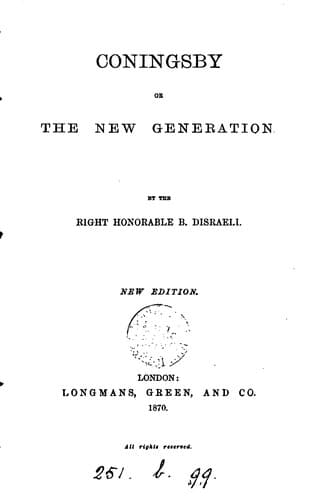
Coningsby; Or, The New GenerationDisraeli, Benjamin, Earl of Beaconsfield
General
Coningsby; Or, The New Generation
Disraeli, Benjamin, Earl of Beaconsfield
Great Britain -- Fiction; Political fiction; Politicians -- Fiction
‘You mean giving up those Irish corporations?’ said Lord Monmouth.
‘Well, between ourselves, I am quite of the same opinion. But we must
mount higher; we must go to ‘28 for the real mischief. But what is the
use of lamenting the past? Peel is the only man; suited to the times and
all that; at least we must say so, and try to believe so; we can’t go
back. And it is our own fault that we have let the chief power out of
the hands of our own order. It was never thought of in the time of your
great-grandfather, sir. And if a commoner were for a season permitted
to be the nominal Premier to do the detail, there was always a secret
committee of great 1688 nobles to give him his instructions.’
‘I should be very sorry to see secret committees of great 1688 nobles
again,’ said Coningsby.
‘Then what the devil do you want to see?’ said Lord Monmouth.
‘Political faith,’ said Coningsby, ‘instead of political infidelity.’
‘Hem!’ said Lord Monmouth.
‘Before I support Conservative principles,’ continued Coningsby, ‘I
merely wish to be informed what those principles aim to conserve. It
would not appear to be the prerogative of the Crown, since the principal
portion of a Conservative oration now is an invective against a late
royal act which they describe as a Bed-chamber plot. Is it the Church
which they wish to conserve? What is a threatened Appropriation Clause
against an actual Church Commission in the hands of Parliamentary
Laymen? Could the Long Parliament have done worse? Well, then, if it
is neither the Crown nor the Church, whose rights and privileges this
Conservative party propose to vindicate, is it your House, the House
of Lords, whose powers they are prepared to uphold? Is it not notorious
that the very man whom you have elected as your leader in that House,
declares among his Conservative adherents, that henceforth the assembly
that used to furnish those very Committees of great revolution nobles
that you mention, is to initiate nothing; and, without a struggle, is
to subside into that undisturbed repose which resembles the Imperial
tranquillity that secured the frontiers by paying tribute?’
‘All this is vastly fine,’ said Lord Monmouth; ‘but I see no means by
which I can attain my object but by supporting Peel. After all, what is
the end of all parties and all politics? To gain your object. I want to
turn our coronet into a ducal one, and to get your grandmother’s barony
called out of abeyance in your favour. It is impossible that Peel can
refuse me. I have already purchased an ample estate with the view
of entailing it on you and your issue. You will make a considerable
alliance; you may marry, if you please, Lady Theresa Sydney. I hear the
report with pleasure. Count on my at once entering into any arrangement
conducive to your happiness.’
‘My dear grandfather, you have ever been to me only too kind and
generous.’
Public-domain text, read in full here on John Shaqi.
Reviews
Reviews
No reviews yet
Be the first to share your thoughts on this work.
Elsewhere in the archive
Join the Discussion
Join the discussion
Sign in to leave a comment or review.
Sign InorCreate an account