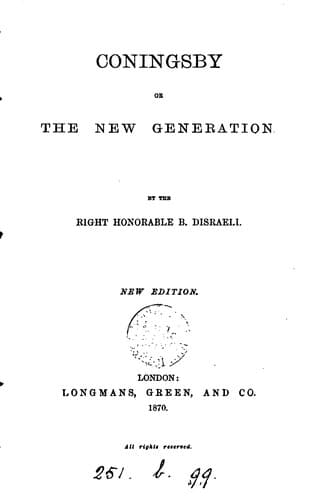
Coningsby; Or, The New GenerationDisraeli, Benjamin, Earl of Beaconsfield
General
Coningsby; Or, The New Generation
Disraeli, Benjamin, Earl of Beaconsfield
Great Britain -- Fiction; Political fiction; Politicians -- Fiction
It would have been difficult for any person, unconscious of crime,
to have felt more dejected than Coningsby when he rode out of the
court-yard of Monmouth House. The love of Edith would have consoled
him for the destruction of his prosperity; the proud fulfilment of his
ambition might in time have proved some compensation for his crushed
affections; but his present position seemed to offer no single source
of solace. There came over him that irresistible conviction that is at
times the dark doom of all of us, that the bright period of our life is
past; that a future awaits us only of anxiety, failure, mortification,
despair; that none of our resplendent visions can ever be realised:
and that we add but one more victim to the long and dreary catalogue of
baffled aspirations.
Nor could he indeed by any combination see the means to extricate
himself from the perils that were encompassing him. There was something
about his grandfather that defied persuasion. Prone as eloquent
youth generally is to believe in the resistless power of its appeals,
Coningsby despaired at once of ever moving Lord Monmouth. There had been
a callous dryness in his manner, an unswerving purpose in his spirit,
that at once baffled all attempts at influence. Nor could Coningsby
forget the look he received when he quitted the room. There was no
possibility of mistaking it; it said at once, without periphrasis,
‘Cross my purpose, and I will crush you!’
This was the moment when the sympathy, if not the counsels, of
friendship might have been grateful. A clever woman might have afforded
even more than sympathy; some happy device that might have even released
him from the mesh in which he was involved. And once Coningsby had
turned his horse’s head to Park Lane to call on Lady Everingham. But
surely if there were a sacred secret in the world, it was the one which
subsisted between himself and Edith. No, that must never be violated.
Then there was Lady Wallinger; he could at least speak with freedom to
her. He resolved to tell her all. He looked in for a moment at a club
to take up the ‘Court Guide’ and find her direction. A few men were
standing in a bow window. He heard Mr. Cassilis say,
‘So Beau, they say, is booked at last; the new beauty, have you heard?’
‘I saw him very sweet on her last night,’ rejoined his companion. ‘Has
she any tin?’
‘Deuced deal, they say,’ replied Mr. Cassilis.’ The father is a cotton
lord, and they all have loads of tin, you know. Nothing like them now.’
‘He is in Parliament, is not he?’
‘’Gad, I believe he is,’ said Mr. Cassilis; ‘I never know who is in
Parliament in these days. I remember when there were only ten men in the
House of Commons who were not either members of Brookes’ or this place.
Everything is so deuced changed.’
‘I hear ‘tis an old affair of Beau,’ said another gentleman. ‘It was all
done a year ago at Rome or Paris.’
‘They say she refused him then,’ said Mr. Cassilis.
Public-domain text, read in full here on John Shaqi.
Reviews
Reviews
No reviews yet
Be the first to share your thoughts on this work.
Elsewhere in the archive
Join the Discussion
Join the discussion
Sign in to leave a comment or review.
Sign InorCreate an account