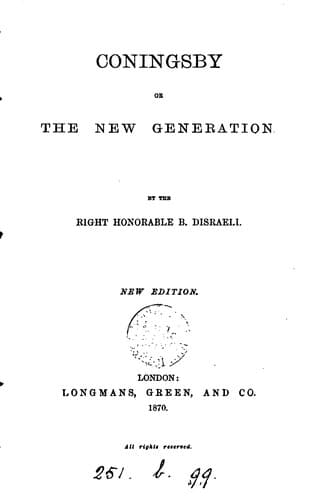
Coningsby; Or, The New GenerationDisraeli, Benjamin, Earl of Beaconsfield
General
Coningsby; Or, The New Generation
Disraeli, Benjamin, Earl of Beaconsfield
Great Britain -- Fiction; Political fiction; Politicians -- Fiction
It would seem, therefore, that Sir Robert Peel, from an early period,
meditated his emancipation from the political confederacy in which
he was implicated, and that he has been continually baffled in this
project. He broke loose from Lord Liverpool; he retired from Mr.
Canning. Forced again into becoming the subordinate leader of the
weakest government in parliamentary annals, he believed he had at length
achieved his emancipation, when he declared to his late colleagues,
after the overthrow of 1830, that he would never again accept a
secondary position in office. But the Duke of Wellington was too old a
tactician to lose so valuable an ally. So his Grace declared after the
Reform Bill was passed, as its inevitable result, that thenceforth
the Prime Minister must be a member of the House of Commons; and this
aphorism, cited as usual by the Duke’s parasites as demonstration of his
supreme sagacity, was a graceful mode of resigning the preeminence which
had been productive of such great party disasters. It is remarkable
that the party who devised and passed the Reform Bill, and who, in
consequence, governed the nation for ten years, never once had their
Prime Minister in the House of Commons: but that does not signify; the
Duke’s maxim is still quoted as an oracle almost equal in prescience
to his famous query, ‘How is the King’s government to be carried on?’
a question to which his Grace by this time has contrived to give a
tolerably practical answer.
Sir Robert Peel, who had escaped from Lord Liverpool, escaped from Mr.
Canning, escaped even from the Duke of Wellington in 1832, was at
length caught in 1834; the victim of ceaseless intriguers, who neither
comprehended his position, nor that of their country.
CHAPTER II.
Beaumanoir was one of those Palladian palaces, vast and ornate, such
as the genius of Kent and Campbell delighted in at the beginning of the
eighteenth century. Placed on a noble elevation, yet screened from the
northern blast, its sumptuous front, connected with its far-spreading
wings by Corinthian colonnades, was the boast and pride of the midland
counties. The surrounding gardens, equalling in extent the size of
ordinary parks, were crowded with temples dedicated to abstract virtues
and to departed friends. Occasionally a triumphal arch celebrated a
general whom the family still esteemed a hero; and sometimes a votive
column commemorated the great statesman who had advanced the family a
step in the peerage. Beyond the limits of this pleasance the hart and
hind wandered in a wilderness abounding in ferny coverts and green and
stately trees.
Public-domain text, read in full here on John Shaqi.
Reviews
Reviews
No reviews yet
Be the first to share your thoughts on this work.
Elsewhere in the archive
Join the Discussion
Join the discussion
Sign in to leave a comment or review.
Sign InorCreate an account