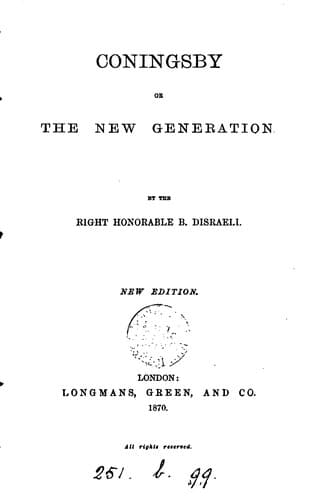
Coningsby; Or, The New GenerationDisraeli, Benjamin, Earl of Beaconsfield
General
Coningsby; Or, The New Generation
Disraeli, Benjamin, Earl of Beaconsfield
Great Britain -- Fiction; Political fiction; Politicians -- Fiction
The noble proprietor of this demesne had many of the virtues of his
class; a few of their failings. He had that public spirit which became
his station. He was not one of those who avoided the exertions and the
sacrifices which should be inseparable from high position, by the hollow
pretext of a taste for privacy, and a devotion to domestic joys. He
was munificent, tender, and bounteous to the poor, and loved a flowing
hospitality. A keen sportsman, he was not untinctured by letters,
and had indeed a cultivated taste for the fine arts. Though an ardent
politician, he was tolerant to adverse opinions, and full of amenity
to his opponents. A firm supporter of the corn-laws, he never refused
a lease. Notwithstanding there ran through his whole demeanour and the
habit of his mind, a vein of native simplicity that was full of charm,
his manner was finished. He never offended any one’s self-love. His good
breeding, indeed, sprang from the only sure source of gentle manners,
a kind heart. To have pained others would have pained himself. Perhaps,
too, this noble sympathy may have been in some degree prompted by the
ancient blood in his veins, an accident of lineage rather rare with the
English nobility. One could hardly praise him for the strong affections
that bound him to his hearth, for fortune had given him the most
pleasing family in the world; but, above all, a peerless wife.
The Duchess was one of those women who are the delight of existence. She
was sprung from a house not inferior to that with which she had blended,
and was gifted with that rare beauty which time ever spares, so that she
seemed now only the elder sister of her own beautiful daughters. She,
too, was distinguished by that perfect good breeding which is the result
of nature and not of education: for it may be found in a cottage, and
may be missed in a palace. ‘Tis a genial regard for the feelings of
others that springs from an absence of selfishness. The Duchess, indeed,
was in every sense a fine lady; her manners were refined and full of
dignity; but nothing in the world could have induced her to appear bored
when another was addressing or attempting to amuse her. She was not one
of those vulgar fine ladies who meet you one day with a vacant stare, as
if unconscious of your existence, and address you on another in a tone
of impertinent familiarity. Her temper, perhaps, was somewhat quick,
which made this consideration for the feelings of others still more
admirable, for it was the result of a strict moral discipline acting
on a good heart. Although the best of wives and mothers, she had some
charity for her neighbours. Needing herself no indulgence, she could be
indulgent; and would by no means favour that strait-laced morality
that would constrain the innocent play of the social body. She was
accomplished, well read, and had a lively fancy. Add to this that
sunbeam of a happy home, a gay and cheerful spirit in its mistress, and
Public-domain text, read in full here on John Shaqi.
Reviews
Reviews
No reviews yet
Be the first to share your thoughts on this work.
Elsewhere in the archive
Join the Discussion
Join the discussion
Sign in to leave a comment or review.
Sign InorCreate an account