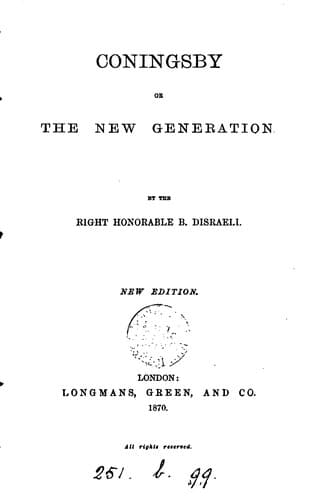
Coningsby; Or, The New GenerationDisraeli, Benjamin, Earl of Beaconsfield
General
Coningsby; Or, The New Generation
Disraeli, Benjamin, Earl of Beaconsfield
Great Britain -- Fiction; Political fiction; Politicians -- Fiction
‘You will have religious cries enough in a short time,’ said Mr. Rigby,
rather wearied of any one speaking but himself, and thereat he commenced
a discourse, which was, in fact, one of his ‘slashing’ articles in petto
on Church Reform, and which abounded in parallels between the present
affairs and those of the reign of Charles I. Tadpole, who did not
pretend to know anything but the state of the registration, and Taper,
whose political reading was confined to an intimate acquaintance with
the Red Book and Beatson’s Political Index, which he could repeat
backwards, were silenced. The Duke, who was well instructed and liked
to be talked to, sipped his claret, and was rather amused by Rigby’s
lecture, particularly by one or two statements characterised by Rigby’s
happy audacity, but which the Duke was too indolent to question. Lord
Fitz-Booby listened with his mouth open, but rather bored. At length,
when there was a momentary pause, he said:
‘In my time, the regular thing was to move an amendment on the address.’
‘Quite out of the question,’ exclaimed Tadpole, with a scoff.
‘Entirely given up,’ said Taper, with a sneer.
‘If you will drink no more claret, we will go and hear some music,’ said
the Duke.
CHAPTER III.
A breakfast at Beaumanoir was a meal of some ceremony. Every guest was
expected to attend, and at a somewhat early hour. Their host and hostess
set them the example of punctuality. ‘Tis an old form rigidly adhered to
in some great houses, but, it must be confessed, does not contrast
very agreeably with the easier arrangements of establishments of less
pretension and of more modern order.
The morning after the dinner to which we have been recently introduced,
there was one individual absent from the breakfast-table whose
non-appearance could scarcely be passed over without notice; and several
inquired with some anxiety, whether their host were indisposed.
‘The Duke has received some letters from London which detain him,’
replied the Duchess. ‘He will join us.’
‘Your Grace will be glad to hear that your son Henry is very well,’ said
Mr. Rigby; ‘I heard of him this morning. Harry Coningsby enclosed me a
letter for his grandfather, and tells me that he and Henry Sydney had
just had a capital run with the King’s hounds.’
‘It is three years since we have seen Mr. Coningsby,’ said the Duchess.
‘Once he was often here. He was a great favourite of mine. I hardly ever
knew a more interesting boy.’
‘Yes, I have done a great deal for him,’ said Mr. Rigby. ‘Lord Monmouth
is fond of him, and wishes that he should make a figure; but how any one
is to distinguish himself now, I am really at a loss to comprehend.’
‘But are affairs so very bad?’ said the Duchess, smiling. ‘I thought
that we were all regaining our good sense and good temper.’
‘I believe all the good sense and all the good temper in England are
concentrated in your Grace,’ said Mr. Rigby, gallantly.
Public-domain text, read in full here on John Shaqi.
Reviews
Reviews
No reviews yet
Be the first to share your thoughts on this work.
Elsewhere in the archive
Join the Discussion
Join the discussion
Sign in to leave a comment or review.
Sign InorCreate an account