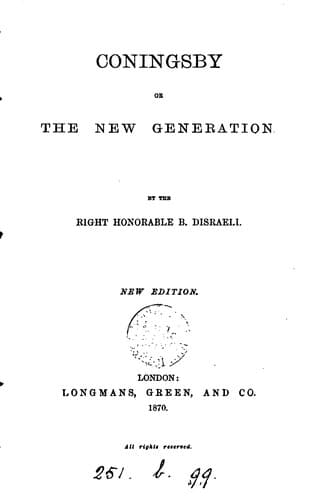
Coningsby; Or, The New GenerationDisraeli, Benjamin, Earl of Beaconsfield
General
Coningsby; Or, The New Generation
Disraeli, Benjamin, Earl of Beaconsfield
Great Britain -- Fiction; Political fiction; Politicians -- Fiction
‘Nay,’ said the stranger; ‘for life in general there is but one decree.
Youth is a blunder; Manhood a struggle; Old Age a regret. Do not
suppose,’ he added, smiling, ‘that I hold that youth is genius; all that
I say is, that genius, when young, is divine. Why, the greatest captains
of ancient and modern times both conquered Italy at five-and-twenty!
Youth, extreme youth, overthrew the Persian Empire. Don John of Austria
won Lepanto at twenty-five, the greatest battle of modern time; had it
not been for the jealousy of Philip, the next year he would have been
Emperor of Mauritania. Gaston de Foix was only twenty-two when he stood
a victor on the plain of Ravenna. Every one remembers Condé and Rocroy
at the same age. Gustavus Adolphus died at thirty-eight. Look at his
captains: that wonderful Duke of Weimar, only thirty-six when he died.
Banier himself, after all his miracles, died at forty-five. Cortes was
little more than thirty when he gazed upon the golden cupolas of Mexico.
When Maurice of Saxony died at thirty-two, all Europe acknowledged the
loss of the greatest captain and the profoundest statesman of the age.
Then there is Nelson, Clive; but these are warriors, and perhaps you may
think there are greater things than war. I do not: I worship the Lord
of Hosts. But take the most illustrious achievements of civil prudence.
Innocent III., the greatest of the Popes, was the despot of Christendom
at thirty-seven. John de Medici was a Cardinal at fifteen, and according
to Guicciardini, baffled with his statecraft Ferdinand of Arragon
himself. He was Pope as Leo X. at thirty-seven. Luther robbed even him
of his richest province at thirty-five. Take Ignatius Loyola and John
Wesley, they worked with young brains. Ignatius was only thirty when he
made his pilgrimage and wrote the “Spiritual Exercises.” Pascal wrote
a great work at sixteen, and died at thirty-seven, the greatest of
Frenchmen.
‘Ah! that fatal thirty-seven, which reminds me of Byron, greater even as
a man than a writer. Was it experience that guided the pencil of Raphael
when he painted the palaces of Rome? He, too, died at thirty-seven.
Richelieu was Secretary of State at thirty-one. Well then, there were
Bolingbroke and Pitt, both ministers before other men left off cricket.
Grotius was in great practice at seventeen, and Attorney-General at
twenty-four. And Acquaviva; Acquaviva was General of the Jesuits,
ruled every cabinet in Europe, and colonised America before he was
thirty-seven. What a career!’ exclaimed the stranger; rising from his
chair and walking up and down the room; ‘the secret sway of Europe! That
was indeed a position! But it is needless to multiply instances! The
history of Heroes is the history of Youth.’
‘Ah!’ said Coningsby, ‘I should like to be a great man.’
The stranger threw at him a scrutinising glance. His countenance was
serious. He said in a voice of almost solemn melody:
‘Nurture your mind with great thoughts. To believe in the heroic makes
heroes.’
Public-domain text, read in full here on John Shaqi.
Reviews
Reviews
No reviews yet
Be the first to share your thoughts on this work.
Elsewhere in the archive
Join the Discussion
Join the discussion
Sign in to leave a comment or review.
Sign InorCreate an account