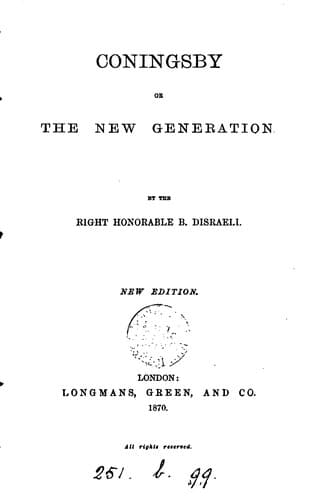
Coningsby; Or, The New GenerationDisraeli, Benjamin, Earl of Beaconsfield
General
Coningsby; Or, The New Generation
Disraeli, Benjamin, Earl of Beaconsfield
Great Britain -- Fiction; Political fiction; Politicians -- Fiction
The day after his adventure at the Forest Inn, Coningsby arrived at
Beaumanoir. It was several years since he had visited the family of his
friend, who were indeed also his kin; and in his boyish days had often
proved that they were not unmindful of the affinity. This was a visit
that had been long counted on, long promised, and which a variety of
circumstances had hitherto prevented. It was to have been made by the
schoolboy; it was to be fulfilled by the man. For no less a character
could Coningsby under any circumstances now consent to claim, since he
was closely verging to the completion of his nineteenth year; and it
appeared manifest that if it were his destiny to do anything great,
he had but few years to wait before the full development of his power.
Visions of Gastons de Foix and Maurices of Saxony, statesmen giving
up cricket to govern nations, beardless Jesuits plunged in profound
abstraction in omnipotent cabinets, haunted his fancy from the moment he
had separated from his mysterious and deeply interesting companion. To
nurture his mind with great thoughts had ever been Coningsby’s inspiring
habit. Was it also destined that he should achieve the heroic?
There are some books, when we close them; one or two in the course of
our life, difficult as it may be to analyse or ascertain the cause; our
minds seem to have made a great leap. A thousand obscure things receive
light; a multitude of indefinite feelings are determined. Our intellect
grasps and grapples with all subjects with a capacity, a flexibility,
and a vigour, before unknown to us. It masters questions hitherto
perplexing, which are not even touched or referred to in the volume just
closed. What is this magic? It is the spirit of the supreme author, by
a magentic influence blending with our sympathising intelligence, that
directs and inspires it. By that mysterious sensibility we extend to
questions which he has not treated, the same intellectual force which he
has exercised over those which he has expounded. His genius for a time
remains in us. ‘Tis the same with human beings as with books. All of us
encounter, at least once in our life, some individual who utters words
that make us think for ever.
There are men whose phrases are oracles; who condense in a sentence the
secrets of life; who blurt out an aphorism that forms a character or
illustrates an existence. A great thing is a great book; but greater
than all is the talk of a great man.
And what is a great man? Is it a Minister of State? Is it a victorious
General? A gentleman in the Windsor uniform? A Field Marshal covered
with stars? Is it a Prelate, or a Prince? A King, even an Emperor?
It may be all these; yet these, as we must all daily feel, are not
necessarily great men. A great man is one who affects the mind of his
generation: whether he be a monk in his cloister agitating Christendom,
or a monarch crossing the Granicus, and giving a new character to the
Pagan World.
Public-domain text, read in full here on John Shaqi.
Reviews
Reviews
No reviews yet
Be the first to share your thoughts on this work.
Elsewhere in the archive
Join the Discussion
Join the discussion
Sign in to leave a comment or review.
Sign InorCreate an account