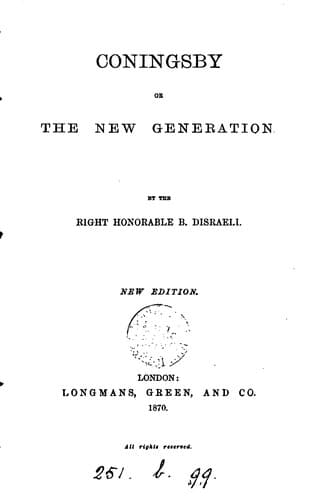
Coningsby; Or, The New GenerationDisraeli, Benjamin, Earl of Beaconsfield
General
Coningsby; Or, The New Generation
Disraeli, Benjamin, Earl of Beaconsfield
Great Britain -- Fiction; Political fiction; Politicians -- Fiction
These were indeed questions that had as yet presented themselves to his
thought in a crude and imperfect form; but their very occurrence showed
the strong predisposition of his mind. It was because he had not found
guides among his elders, that his thoughts had been turned to the
generation that he himself represented. The sentiment of veneration was
so developed in his nature, that he was exactly the youth that would
have hung with enthusiastic humility on the accents of some sage of old
in the groves of Academus, or the porch of Zeno. But as yet he had found
age only perplexed and desponding; manhood only callous and desperate.
Some thought that systems would last their time; others, that something
would turn up. His deep and pious spirit recoiled with disgust and
horror from such lax, chance-medley maxims, that would, in their
consequences, reduce man to the level of the brutes. Notwithstanding
a prejudice which had haunted him from his childhood, he had, when
the occasion offered, applied to Mr. Rigby for instruction, as one
distinguished in the republic of letters, as well as the realm of
politics; who assumed the guidance of the public mind, and, as the
phrase runs, was looked up to. Mr. Rigby listened at first to the
inquiries of Coningsby, urged, as they ever were, with a modesty and
deference which do not always characterise juvenile investigations, as
if Coningsby were speaking to him of the unknown tongues. But Mr.
Rigby was not a man who ever confessed himself at fault. He caught
up something of the subject as our young friend proceeded, and was
perfectly prepared, long before he had finished, to take the whole
conversation into his own hands.
Mr. Rigby began by ascribing everything to the Reform Bill, and then
referred to several of his own speeches on Schedule A. Then he told
Coningsby that want of religious Faith was solely occasioned by want of
churches; and want of Loyalty, by George IV. having shut himself up too
much at the cottage in Windsor Park, entirely against the advice of Mr.
Rigby. He assured Coningsby that the Church Commission was operating
wonders, and that with private benevolence, he had himself subscribed
1,000_l._, for Lord Monmouth, we should soon have churches enough. The
great question now was their architecture. Had George IV. lived all
would have been right. They would have been built on the model of the
Budhist pagoda. As for Loyalty, if the present King went regularly to
Ascot races, he had no doubt all would go right. Finally, Mr. Rigby
impressed on Coningsby to read the Quarterly Review with great
attention; and to make himself master of Mr. Wordy’s History of the late
War, in twenty volumes, a capital work, which proves that Providence was
on the side of the Tories.
Public-domain text, read in full here on John Shaqi.
Reviews
Reviews
No reviews yet
Be the first to share your thoughts on this work.
Elsewhere in the archive
Join the Discussion
Join the discussion
Sign in to leave a comment or review.
Sign InorCreate an account