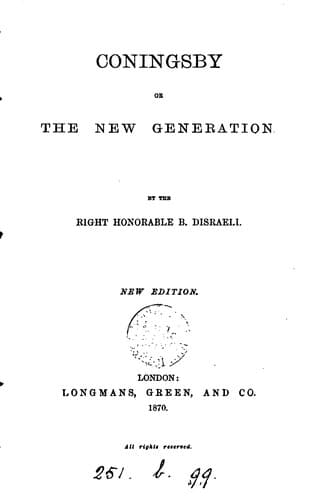
Coningsby; Or, The New GenerationDisraeli, Benjamin, Earl of Beaconsfield
General
Coningsby; Or, The New Generation
Disraeli, Benjamin, Earl of Beaconsfield
Great Britain -- Fiction; Political fiction; Politicians -- Fiction
Perhaps Lady Theresa, too, might have welcomed him with more freedom
had his appearance also more accorded with the image which he had left
behind. Coningsby was a boy then, as we described him in our first
chapter. Though only nineteen now, he had attained his full stature,
which was above the middle height, and time had fulfilled that promise
of symmetry in his figure, and grace in his mien, then so largely
intimated. Time, too, which had not yet robbed his countenance of any
of its physical beauty, had strongly developed the intellectual charm
by which it had ever been distinguished. As he bowed lowly before the
Duchess and her daughter, it would have been difficult to imagine a
youth of a mien more prepossessing and a manner more finished.
A manner that was spontaneous; nature’s pure gift, the reflex of his
feeling. No artifice prompted that profound and polished homage. Not one
of those influences, the aggregate of whose sway produces, as they tell
us, the finished gentleman, had ever exercised its beneficent power on
our orphan, and not rarely forlorn, Coningsby. No clever and refined
woman, with her quick perception, and nice criticism that never offends
our self-love, had ever given him that education that is more precious
than Universities. The mild suggestions of a sister, the gentle raillery
of some laughing cousin, are also advantages not always appreciated at
the time, but which boys, when they have become men, often think over
with gratitude, and a little remorse at the ungracious spirit in
which they were received. Not even the dancing-master had afforded his
mechanical aid to Coningsby, who, like all Eton boys of his generation,
viewed that professor of accomplishments with frank repugnance. But even
in the boisterous life of school, Coningsby, though his style was free
and flowing, was always well-bred. His spirit recoiled from that gross
familiarity that is the characteristic of modern manners, and which
would destroy all forms and ceremonies merely because they curb and
control their own coarse convenience and ill-disguised selfishness. To
women, however, Coningsby instinctively bowed, as to beings set apart
for reverence and delicate treatment. Little as his experience was
of them, his spirit had been fed with chivalrous fancies, and he
entertained for them all the ideal devotion of a Surrey or a Sydney.
Instructed, if not learned, as books and thought had already made him in
men, he could not conceive that there were any other women in the world
than fair Geraldines and Countesses of Pembroke.
Public-domain text, read in full here on John Shaqi.
Reviews
Reviews
No reviews yet
Be the first to share your thoughts on this work.
Elsewhere in the archive
Join the Discussion
Join the discussion
Sign in to leave a comment or review.
Sign InorCreate an account