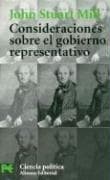
Considerations on Representative GovernmentMill, John Stuart
PhilosophyPhilosophy
Considerations on Representative Government
Mill, John Stuart
Representative government and representation
a right, will scarcely accept the conclusions to which their doctrine
leads. If it is a right, if it belongs to the voter for his own sake,
on what ground can we blame him for selling it, or using it to
recommend himself to any one whom it is his interest to please? A
person is not expected to consult exclusively the public benefit in
the use he makes of his house, or his three per cent. stock, or any
thing else to which he really has a right. The suffrage is indeed due
to him, among other reasons, as a means to his own protection, but
only against treatment from which he is equally bound, so far as
depends on his vote, to protect every one of his fellow-citizens. His
vote is not a thing in which he has an option; it has no more to do
with his personal wishes than the verdict of a juryman. It is strictly
a matter of duty; he is bound to give it according to his best and
most conscientious opinion of the public good. Whoever has any other
idea of it is unfit to have the suffrage; its effect on him is to
pervert, not to elevate his mind. Instead of opening his heart to an
exalted patriotism and the obligation of public duty, it awakens and
nourishes in him the disposition to use a public function for his own
interest, pleasure, or caprice; the same feelings and purposes, on a
humbler scale, which actuate a despot and oppressor. Now an ordinary
citizen in any public position, or on whom there devolves any social
function, is certain to think and feel, respecting the obligations it
imposes on him, exactly what society appears to think and feel in
conferring it. What seems to be expected from him by society forms a
standard which he may fall below, but which he will seldom rise above.
And the interpretation which he is almost sure to put upon secret
voting is that he is not bound to give his vote with any reference to
those who are not allowed to know how he gives it; but may bestow it
simply as he feels inclined.
Public-domain text, read in full here on John Shaqi.
Reviews
Reviews
No reviews yet
Be the first to share your thoughts on this work.
Elsewhere in the archive
Join the Discussion
Join the discussion
Sign in to leave a comment or review.
Sign InorCreate an account