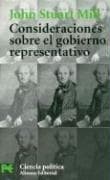
Considerations on Representative GovernmentMill, John Stuart
PhilosophyPhilosophy
Considerations on Representative Government
Mill, John Stuart
Representative government and representation
On the other debateable points connected with the mode of voting, it
is not necessary to expend so many words. The system of personal
representation, as organized by Mr. Hare, renders necessary the
employment of voting papers. But it appears to me indispensable that
the signature of the elector should be affixed to the paper at a
public polling-place, or if there be no such place conveniently
accessible, at some office open to all the world, and in the presence
of a responsible public officer. The proposal which has been thrown
out of allowing the voting papers to be filled up at the voter's own
residence, and sent by the post, or called for by a public officer, I
should regard as fatal. The act would be done in the absence of the
salutary and the presence of all the pernicious influences. The briber
might, in the shelter of privacy, behold with his own eyes his
bargain fulfilled, and the intimidator could see the extorted
obedience rendered irrevocably on the spot; while the beneficent
counter-influence of the presence of those who knew the voter's real
sentiments, and the inspiring effect of the sympathy of those of his
own party or opinion, would be shut out. [5]
The polling places should be so numerous as to be within easy reach of
every voter, and no expenses of conveyance, at the cost of the
candidate, should be tolerated under any pretext. The infirm, and they
only on medical certificate, should have the right of claiming
suitable carriage conveyance at the cost of the state or of the
locality. Hustings, poll clerks, and all the necessary machinery of
elections, should be at the public charge. Not only the candidate
should not be required, he should not be permitted to incur any but a
limited and trifling expense for his election. Mr. Hare thinks it
desirable that a sum of £50 should be required from every one who
places his name on the list of candidates, to prevent persons who have
no chance of success, and no real intention of attempting it, from
becoming candidates in wantonness or from mere love of notoriety, and
perhaps carrying off a few votes which are needed for the return of
more serious aspirants. There is one expense which a candidate or his
supporters can not help incurring, and which it can hardly be expected
that the public should defray for every one who may choose to demand
it--that of making his claims known to the electors, by
advertisements, placards, and circulars. For all necessary expenses of
this kind the £50 proposed by Mr. Hare, if allowed to be drawn upon
for these purposes (it might be made £100 if requisite), ought to be
sufficient. If the friends of the candidate choose to go to expense
for committees and canvassing, there are no means of preventing them;
but such expenses out of the candidates's own pocket, or any expenses
whatever beyond the deposit of £50 (or £100), should be illegal and
punishable. If there appeared any likelihood that opinion would refuse
Public-domain text, read in full here on John Shaqi.
Reviews
Reviews
No reviews yet
Be the first to share your thoughts on this work.
Elsewhere in the archive
Join the Discussion
Join the discussion
Sign in to leave a comment or review.
Sign InorCreate an account