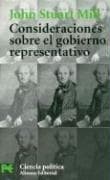
Considerations on Representative GovernmentMill, John Stuart
PhilosophyPhilosophy
Considerations on Representative Government
Mill, John Stuart
Representative government and representation
The historical antecedents of England render it all but certain that,
unless in the improbable case of a violent subversion of the existing
Constitution, any second Chamber which could possibly exist would have
to be built on the foundation of the House of Lords. It is out of the
question to think practically of abolishing that assembly, to replace
it by such a Senate as I have sketched or by any other; but there
might not be the same insuperable difficulty in aggregating the
classes or categories just spoken of to the existing body in the
character of peers for life. An ulterior, and perhaps, on this
supposition, a necessary step, might be, that the hereditary peerage
should be present in the House by their representatives instead of
personally: a practice already established in the case of the Scotch
and Irish peers, and which the mere multiplication of the order will
probably at some time or other render inevitable. An easy adaptation
of Mr. Hare's plan would prevent the representative peers from
representing exclusively the party which has the majority in the
peerage. If, for example, one representative were allowed for every
ten peers, any ten might be admitted to choose a representative, and
the peers might be free to group themselves for that purpose as they
pleased. The election might be thus conducted: All peers who were
candidates for the representation of their order should be required to
declare themselves such, and enter their names in a list. A day and
place should be appointed at which peers desirous of voting should be
present, either in person, or, in the usual Parliamentary manner, by
their proxies. The votes should be taken, each peer voting for only
one. Every candidate who had as many as ten votes should be declared
elected. If any one had more, all but ten should be allowed to
withdraw their votes, or ten of the number should be selected by lot.
These ten would form his constituency, and the remainder of his voters
would be set free to give their votes over again for some one else.
This process should be repeated until (so far as possible) every peer
present either personally or by proxy was represented. When a number
less than ten remained over, if amounting to five they might still be
allowed to agree on a representative; if fewer than five, their votes
must be lost, or they might be permitted to record them in favor of
somebody already elected. With this inconsiderable exception, every
representative peer would represent ten members of the peerage, all of
whom had not only voted for him, but selected him as the one, among
all open to their choice, by whom they were most desirous to be
represented. As a compensation to the peers who were not chosen
representatives of their order, they should be eligible to the House
of Commons; a justice now refused to Scotch peers, and to Irish peers
in their own part of the kingdom, while the representation in the
House of Lords of any but the most numerous party in the peerage is
Public-domain text, read in full here on John Shaqi.
Reviews
Reviews
No reviews yet
Be the first to share your thoughts on this work.
Elsewhere in the archive
Join the Discussion
Join the discussion
Sign in to leave a comment or review.
Sign InorCreate an account