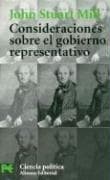
Considerations on Representative GovernmentMill, John Stuart
PhilosophyPhilosophy
Considerations on Representative Government
Mill, John Stuart
Representative government and representation
first votes being preferred to second, second to third, and so forth.
The voting papers, and all the elements of the calculation, would be
placed in public repositories, accessible to all whom they concerned;
and if any one who had obtained the quota was not duly returned, it
would be in his power easily to prove it.
These are the main provisions of the scheme. For a more minute
knowledge of its very simple machinery, I must refer to Mr. Hare's
"Treatise on the Election of Representatives" (a small volume
Published in 1859), and to a pamphlet by Mr. Henry Fawcett, published
in 1860, and entitled "Mr. Hare's Reform Bill simplified and
explained." This last is a very clear and concise exposition of the
plan, reduced to its simplest elements by the omission of some of Mr.
Hare's original provisions, which, though in themselves beneficial,
we're thought to take more from the simplicity of the scheme than they
added to its practical advantages. The more these works are studied,
the stronger, I venture to predict, will be the impression of the
perfect feasibility of the scheme and its transcendant advantages.
Such and so numerous are these, that, in my conviction, they place Mr.
Hare's plan among the very greatest improvements yet made in the
theory and practice of government.
In the first place, it secures a representation, in proportion to
numbers, of every division of the electoral body: not two great
parties alone, with perhaps a few large sectional minorities in
particular places, but every minority in the whole nation, consisting
of a sufficiently large number to be, on principles of equal justice,
entitled to a representative. Secondly, no elector would, as at
present, be nominally represented by some one whom he had not chosen.
Every member of the House would be the representative of a unanimous
constituency. He would represent a thousand electors, or two thousand,
or five thousand, or ten thousand, as the quota might be, every one of
whom would have not only voted for him, but selected him from the
whole country; not merely from the assortment of two or three perhaps
rotten oranges, which may be the only choice offered to him in his
local market. Under this relation the tie between the elector and the
representative would be of a strength and a value of which at present
we have no experience. Every one of the electors would be personally
identified with his representative, and the representative with his
constituents. Every elector who voted for him would have done so
either because he is the person, in the whole list of candidates for
Parliament, who best expresses the voter's own opinions, or because he
is one of those whose abilities and character the voter most respects,
and whom he most willingly trusts to think for him. The member would
represent persons, not the mere bricks and mortar of the town--the
voters themselves, not a few vestrymen or parish notabilities merely.
Public-domain text, read in full here on John Shaqi.
Reviews
Reviews
No reviews yet
Be the first to share your thoughts on this work.
Elsewhere in the archive
Join the Discussion
Join the discussion
Sign in to leave a comment or review.
Sign InorCreate an account