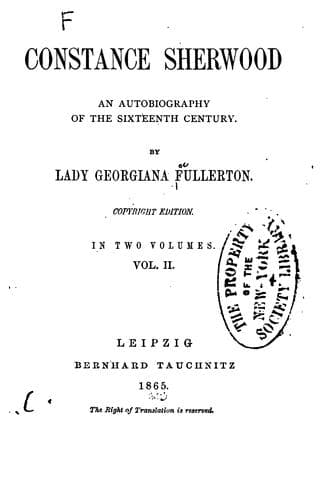
Constance Sherwood: An Autobiography of the Sixteenth CenturyFullerton, Georgiana
History
Constance Sherwood: An Autobiography of the Sixteenth Century
Fullerton, Georgiana
Great Britain -- History -- Elizabeth, 1558-1603 -- Fiction
On the next morning Mr. Congleton called me into the library from the
garden, where I was gathering for Muriel a few of such hardy flowers
as had survived the early frost. She was wont to carry them with her
to the prisons; for it was one of her kindly apprehensions of the
sufferings of others to divide the comfort wherewith things seemingly
indifferent do affect those that be shut out of all kinds of
enjoyments; and where a less tender nature should have been content to
provide necessaries, she, through a more delicate acquaintanceship and
light touch, as it were, on the strings of the human heart, ever
bethought herself when it was possible to minister if but one minute's
pleasure to those who had often well-nigh forgotten the very taste of
it. And she hath told me touching that point of flowers, how it had
once happened that the scent of some violets she had concealed in her
bosom with a like intent did move to tears an aged man, who for many
years past had not seen, no not so much as one green leaf in his
prison; which tears, he said, did him more good than anything else
which could have happened to him.
I threw down on a bench the chrysanthemums and other bold blossoms I
had gathered, and running into the house, opened the door of the
library, where, lo and behold, to my no small agitation and amaze, I
discovered Edmund Genings, who cried out as I entered:
"O my dear master's daughter and well-remembered playmate, I do greet
you with all mine heart; and I thank God that I see you in so good a
condition, as I may with infinite gladness make report of to
your good father, who through me doth impart to you his paternal
blessing and most affectionate commendations."
"Edmund," I cried, scarce able to speak for haste, "is he in London?
is he in prison?"
"No, forsooth," quoth Mr. Congleton.
"No, verily," quoth Edmund; both at the same time.
"Thy fears, silly wench," added the first, "have run away with thy
wits, and I do counsel thee another time to be at more pains to
restrain them; for when there be so many occasions to be afraid of
veritable evils, 'tis but sorry waste to spend fears on present
fancies."
By which I did conjecture my uncle not to be greatly pleased with
Edmund's coming to his house, and noticed that he did fidget in his
chair and ever and anon glanced at the windows which opened on the
garden in an uneasy manner.
"And wherefore art thou then in London?" I asked of Edmund; who thus
answered:
Public-domain text, read in full here on John Shaqi.
Reviews
Reviews
No reviews yet
Be the first to share your thoughts on this work.
Elsewhere in the archive
Join the Discussion
Join the discussion
Sign in to leave a comment or review.
Sign InorCreate an account