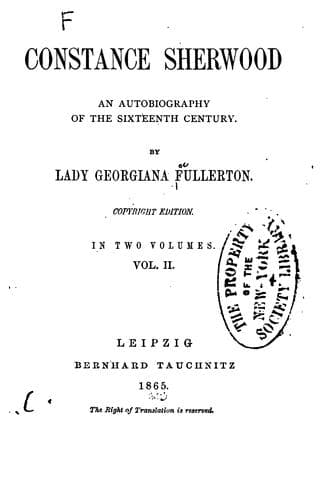
Constance Sherwood: An Autobiography of the Sixteenth CenturyFullerton, Georgiana
History
Constance Sherwood: An Autobiography of the Sixteenth Century
Fullerton, Georgiana
Great Britain -- History -- Elizabeth, 1558-1603 -- Fiction
"And art thou reconciled, Edmund?" I asked, ever speaking hastily and
beforehand with prudence. Mr. Congleton checked me sharply; whereupon,
with great confusion, I interrupted my speech; but Edmund, albeit not
in words yet by signs, answered my question so as I should be
certified it was even as I hoped. He then asked if I should not be
glad to write a letter to my father,--which he would carry to him, so
that it was neither signed nor addressed,--which letter I did sit down
to compose in a hurried manner, my heart prompting my pen to utter
what it listed, rather than weighing the words in which those
affectionate sentiments were expressed. Mr. Congleton likewise did
write to him, whilst Edmund took some food, which he greatly needed;
for he had scarce eaten so much as one comfortable meal since he had
been in London, and was to ride day and night till he reached his
master. I wept very bitterly when he went away; for the sight of him
recalled the dear mother I had lost, the sole parent whose company I
was likewise reft of, and the home I was never like to see again. But
when those tears were stayed, that which at the time did cause sadness
ministered comfort in the retrospect, and relief from worse fears made
the present separation from my father more tolerable. And on the next
Sunday, when I went to the Charter House, with my cousins and Mistress
Ward, I was in such good cheer that Polly commended my prating; which
she said for some days had been so stayed that she had greatly feared
I had caught the infectious plague of melancholy from Kate, whom she
vowed did half kill her with the sound of her doleful sighing since
Mr. Lacy was gone, which she said was a dismal music brought into
fashion by love-sick ladies, and such as she never did intend to
practise; "for," quoth she, "I hold care to be the worst enemy in
life; and to be in love very dull sport, if it serve not to make one
merry." This she said turning to Sir Ralph Ingoldby, the
afore-mentioned suitor for her hand, who went with us, and thereupon
cried out, "Mercy on us, fair mistress, if we must be merry when we be
sad, and by merriment win a lady's love, the lack of which doth so
take away merriment that we must needs be sad, and so lose that which
should cure sadness;" and much more he in that style, and she
answering and making sport of his discourse, as was her wont with all
gentlemen.
When we reached the house, Mrs. Milicent was awaiting us at the door
of the gallery for to conduct us to the best place wherein we could
see her majesty's entrance. There were some seats there and other
persons present, some of which were of Polly's acquaintance, with whom
she did keep up a brisk conversation, in which I had occasion to
notice the sharpness of her wit, in which she did surpass any woman I
have since known, for she was never at a loss for an answer; as when
one said to her--
"Truly, you have no mean opinion of yourself, fair mistress."
Public-domain text, read in full here on John Shaqi.
Reviews
Reviews
No reviews yet
Be the first to share your thoughts on this work.
Elsewhere in the archive
Join the Discussion
Join the discussion
Sign in to leave a comment or review.
Sign InorCreate an account