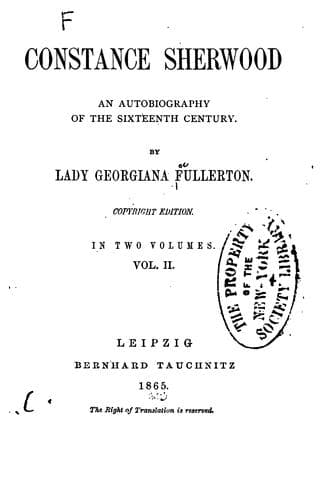
Constance Sherwood: An Autobiography of the Sixteenth CenturyFullerton, Georgiana
History
Constance Sherwood: An Autobiography of the Sixteenth Century
Fullerton, Georgiana
Great Britain -- History -- Elizabeth, 1558-1603 -- Fiction
for his great parts, and nobleness of mind and heart, and withal most
attractive manners,--had not sent him a message, in the middle of the
night, to the effect that he should instantly leave the city, and take
measures for to escape abroad. So, under the name of Patrick, and
wearing the livery of the Earl of Kildare, he travelled to a port
twenty miles from Dublin, and there embarked for England. The queen's
officers, coming on board the ship whereon he had taken his passage,
before it sailed, searched it all over; but through God's mercy, he
said, and St. Patrick's prayers, whose name he had taken, no one did
recognize him, and he passed to London; and the day after, my lord
sent him over to Flanders. So much as the bishop did know thereon, he
related unto me, and stinted not in his praise of his great merits,
and lamentations for what he called his perversion; and hence he took
occasion to speak of religion. And when I said I had been brought up
in the Catholic religion, albeit I now conformed to the times, he said
he would show me the way to be Catholic and still obey the laws, and
that I might yet believe for the most part what I had learnt from my
teachers, so be I renounced the Pope, and commended my saying the
prayers I had been used to; which, he doubted not, were more pleasing
to God than such as some ministers do recite out of their own heads,
whom he did grieve to hear frequented our house, and were no better
than heretics, such as Mr. Fox and Mr. Fulke and Mr. Charke, and the
like of them. But what did much content me was, that he mislikes the
cruel usage recusants do meet with; and he said, not as if boasting of
it, but to declare his mind thereon, that he had often sent them alms
who suffered for their conscience' sake, as many do at this time. But
that I was to remember many Protestants were burnt in the late queen's
time, and that if Papists were not kept under by strict laws, the like
might happen again."
[Footnote 2: State Papers.]
"You should have told him," I cried, who had been silent longer than I
liked, "that Protestants are burnt also in this reign, by the same
token that some Anabaptists did so suffer a short time back, to your
Mr. Fox's no small disgust, who should will none but Catholics to be
put to death."
"Content thee, good Constance," my lady answered; "I be not so
furnished with arguments as thou in a like case wouldst be. So I only
said, I would to God none were burnt, or hanged, or tortured any more
in this country, or in the world at all, for religion; and my lord of
Gloucester declared he was of the same mind, and would have none so
dealt with, if he could mend it, here or abroad. Then the queen rising
to go, our discourse came to an end; but this good bishop says he will
visit me when he next doth come to London, and make that matter plain
to me how I can remain Catholic, and obey the queen, and content his
grace."
Public-domain text, read in full here on John Shaqi.
Reviews
Reviews
No reviews yet
Be the first to share your thoughts on this work.
Elsewhere in the archive
Join the Discussion
Join the discussion
Sign in to leave a comment or review.
Sign InorCreate an account