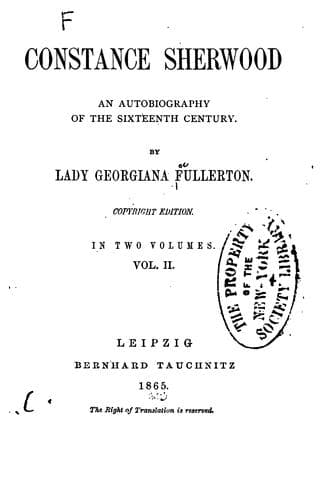
Constance Sherwood: An Autobiography of the Sixteenth CenturyFullerton, Georgiana
History
Constance Sherwood: An Autobiography of the Sixteenth Century
Fullerton, Georgiana
Great Britain -- History -- Elizabeth, 1558-1603 -- Fiction
Kate was dressed in a kirtle of white silk, her head attired with an
habiliment of gold, and her hair, brighter itself than gold, woven
about her face in cunningly wrought tresses. She was led to church
between two gentlemen--Mr. Tresham and Mr. Hogdson--friends of the
bridegroom, who had bride-laces and rosemary tied about their silken
sleeves. There was a fair cup of silver gilt carried before her,
wherein was a goodly branch of rosemary, gilded very fair, and hung
about with silken ribbons of all colors. Musicians came next; then a
group of maidens bearing garlands finely gilded; and thus we passed on
to the church. The common people at the door cheered the bride, whose
fair face was a passport to their favor; but as Muriel crept along,
leaning on my arm, I caught sound of murmured blessings.
"Sweet saint," quoth an aged man, leaning on his staff, near the
porch, "I ween thine espousals be not of earth." A woman, with a child
in her arms, whispered to her as she past, "He thou knowest of is
dead, and died praying for thee." A man, whose eyes had watched her
painfully ascending the steps, called her an angel; whereupon a beggar
with a crutch cried out, "Marry, a lame angel!" A sweet smile was on
her face as she turned toward him; and drawing a piece of silver from
her pocket, she bestowed it on him, with some such words as
these--that she prayed they might both be so happy, albeit lame, as to
hobble to heaven, and get there in good time, if it should please God.
Then he fell to blessing her so loud, that she hurried me into the
church, not content to be thanked in so public a manner.
After the ceremony, we returned in the same order to Ely Place. The
banquet which followed, and the sports succeeding it, were conducted
in a private and somewhat quiet fashion, and not many guests invited,
by reason of the times, and Mr. Congleton misliking to draw notice to
his house, which had hitherto been but little molested, partly for
that Sir Francis Walsingham had a friendship for him, and also for his
sister, Lady Egerton of Ridley, which procured for them greater favor,
in the way of toleration, than is extended to others; and likewise the
Portuguese ambassador was his very good friend, and his chapel open to
us at all times; so that priests did not need to come to his house for
the performance of any religious actions, except that one of the
marriage, which had taken place the night before in his library.
Howsoever, he was very well known to be a recusant, for that neither
himself, nor any belonging to him, attended Protestant worship; and
Sir Francis sometimes told him that the clemency with which he was
treated was shown toward him with the hope that, by mild courses, he
might be soon brought to some better conformity.
Public-domain text, read in full here on John Shaqi.
Reviews
Reviews
No reviews yet
Be the first to share your thoughts on this work.
Elsewhere in the archive
Join the Discussion
Join the discussion
Sign in to leave a comment or review.
Sign InorCreate an account