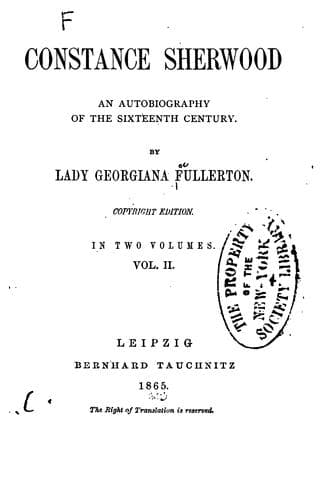
Constance Sherwood: An Autobiography of the Sixteenth CenturyFullerton, Georgiana
History
Constance Sherwood: An Autobiography of the Sixteenth Century
Fullerton, Georgiana
Great Britain -- History -- Elizabeth, 1558-1603 -- Fiction
"Master Tregony, your task shall be to dispute with Master Sherwood;
and this the theme of your argument, 'The Art of Tormenting.' He who
shall describe the nicest instances of such skill, when exercised by a
master toward his servant, a parent to his child, a husband to his
wife, a wife to her husband, a lover to his mistress, or a friend to
his friend, shall be proclaimed victorious; and his adversary submit
to such penance as the court shall inflict."
Master Sherwood shook his head for to decline to enter these lists;
but all the young gentlemen and ladies cried, he should not be
suffered to show contempt of the court, and forced him to stand up.
Master Martin was nothing loth, and in his ill-favored countenance
there appeared a made smile, which did indicate an assurance of
victory; so he began:
"The more wit a man hath, the better able he shall be at times to
torment another; so I do premise, and at the outset of this argument
declare, that to blame a man for the exercise of a talent he doth
possess is downright impiety, and that to wound another by the
pungency of home-thrusts in conversation is as just a liberty in an
ingenious man, as the use of his sword in a battle is to a soldier."
Mr. Sherwood upon this replied, that he did allow a public
disputation, appointed by meet judges, to come under the name of a
fair battle; but even in a battle (he said) generous combatants aim
not so much at wounding their adversaries, as to the disarming of
them; and that he who in private conversation doth make a weapon of
his tongue is like unto the man who provokes another to a single
combat, which for Christians is not lawful, and pierces him easily who
has less skill in wielding the sword than himself.
"Marry, sir," quoth Master Martin, "if you do bring piety into your
discourse, methinks the rules of just debate be not observed; for it
is an unfair thing for to overrule a man with arguments he doth not
dare to reply to under pain of spiritual censures."
"I cry you mercy, Master Martin," quoth the other; "you did bring in
_im_piety, and so methought piety should not be excluded." At the which
we all applauded, and Martin began to perceive his adversary to be
less contemptible than he had supposed.
"Now to the point," I cried; "for exordiums be tedious. I pray you,
gentlemen, begin, and point out some notable fashion wherewith a
master might torment his servant."
Upon which quoth Martin: "If a man hath a sick servant, and doth note
his fancy to be set on some indulgence not of strict necessity, and
should therefore deny it to him, methinks that should be a rare
opportunity to exercise his talent."
"Nay," cried Master Sherwood, "a nicer one, and ever at hand
afterward, should be to show kindness once to a dependent when sick,
and to use him ten times the worse for it when he is well, upbraiding
him for such past favors, as if one should say: 'Alack, be as kind as
you will, see what return you do meet with!'"
Public-domain text, read in full here on John Shaqi.
Reviews
Reviews
No reviews yet
Be the first to share your thoughts on this work.
Elsewhere in the archive
Join the Discussion
Join the discussion
Sign in to leave a comment or review.
Sign InorCreate an account