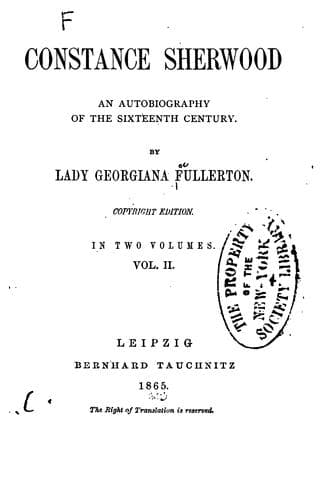
Constance Sherwood: An Autobiography of the Sixteenth CenturyFullerton, Georgiana
History
Constance Sherwood: An Autobiography of the Sixteenth Century
Fullerton, Georgiana
Great Britain -- History -- Elizabeth, 1558-1603 -- Fiction
Poor Lady Tregony's heart did almost break at this his end and her
kinsman's part in it; and during those six months--for she would not
leave London whilst Thomas Sherwood was yet alive--I did constantly
visit her, almost every day, and betwixt us there did exist a sort of
fellowship in our sorrow for this worthy young man's sufferings; for
that she did reproach herself for lack of prudence in not sufficient
distrust of her own nephew, whom now she refused to see, at least, she
said, until he had repented of his sin, which he, glorying in, had
told her, the only time they had met, he should serve her in the same
manner, and if he could ever find out she heard mass, should get her a
lodging in the Tower, and for himself her estate in Norfolk, whither
she was then purposing to retire, and did do so after Master
Sherwood's execution. For mine own part, as once before my father's
apprehended danger had diverted my mind from childish folly, so did
the tragical result of an entertainment, wherein I had been carried
away by thoughtless mirth, somewhat sicken me of company and sports. I
went abroad not much the next year; only was often at Mr. Wells's
house, and in Hubert's society, which had become so habitual to me
that I was almost persuaded the pleasure I took therein proceeded from
a mutual inclination, and I could observe with what jealousy he
watched any whom I did seem to speak with or allow of any civility at
their hands. Even Master Sherwood he would jalouse, if he found me
weeping over his fate; and said he was happier in prison, for whom
such tears did flow, than he at liberty, for whom I showed no like
regard. "Oh," I would answer, "he is happy because, Master Rookwood,
his sufferings are for his God and his conscience' sake, and not such
as arise from a poor human love. Envy him his faith, his patience, his
hope, which make him cry out, as I know he doth, 'O my Lord Jesu! I am
not worthy that I should suffer these things for thee;' and not the
compassionate tears of a paltry wench that in some sort was the means
to plunge him in these straits."
Public-domain text, read in full here on John Shaqi.
Reviews
Reviews
No reviews yet
Be the first to share your thoughts on this work.
Elsewhere in the archive
Join the Discussion
Join the discussion
Sign in to leave a comment or review.
Sign InorCreate an account