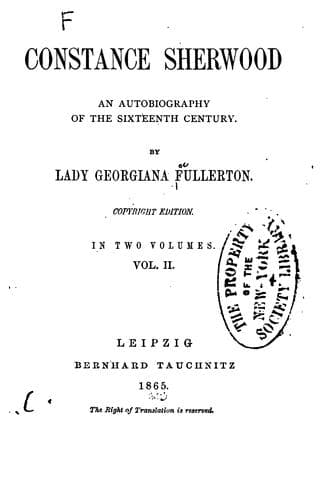
Constance Sherwood: An Autobiography of the Sixteenth CenturyFullerton, Georgiana
History
Constance Sherwood: An Autobiography of the Sixteenth Century
Fullerton, Georgiana
Great Britain -- History -- Elizabeth, 1558-1603 -- Fiction
l'Estrange came out, who, when she perceived me standing before
her, gave a start, but recovering herself, said, good-naturedly:
"Marry, if this be not the ghost we have been looking for; now
ashamed, I ween, to show itself. I hope, Mistress Sherwood, you do not
haunt quiet folks in their beds at night; for I do, I warn you,
mislike living ghosts, and should be disposed to throw a jug of water
at the head of such a one." And laughing, she took my hand in a kind
manner, which when she did, almost a cry broke from her: "How now,
Milicent! she is as cold as a stone figure. Where has she been
chilling herself?"
Milicent pressed forward and led me to my chamber, wherein a fire had
been lighted, and would make me drink a hot posset. But when I thought
of the cold hollow of a tree wherein my father was enclosed, if it
pleased God no worse mishap had befallen him, little of it could I
force myself to swallow, for now tears had come to my relief, and
concealing my face in the pillow of the bed whereon for weariness I
had stretched myself, I wept very bitterly.
"Is that poor man gone from Rugeley's house?" Milicent whispered.
Alas! she knew not who that poor man was to me, nor with what anguish
I answered: "He is not in the cottage, I hope; but God only
knoweth if his pursuers shall not discover him." The thought of what
would then follow overcame me, and I hid my face with mine hands.
"Oh, Constance," she exclaimed, "was this poor man known to thee, that
thy grief is so great, whose conscience doth not reproach thee as mine
doeth?"
I held out my hand to her without unshading my face with the other,
and said: "Dear Milicent! thou shouldst not sorrow so mach for thine
own part in this sore trial. It was not thy fault. He said so. He
blest thee, and prays for thee."
Uncomforted by my words, she cried again, what she had so often
exclaimed that night, "If this man should die, my happiness is over."
Then once more she asked me if I know this priest, and I was froward
with her (God forgive me, for the suspense and fear overthrew better
feelings for a moment), and I cried, angrily, "Who saith he is a
priest? Who can prove it?"
"Think you so?" she said joyfully; "then all should be right."
And once more, with some misdoubting, I ween, that I concealed
somewhat from her, she inquired touching my knowledge of this
stranger. Then I spoke harshly, and bade her leave me, for I had
sorrow enough without her intermeddling with it; but then grieving for
her, and also afraid to be left alone, I denied my words, and prayed
her to stay, which she did, but did not speak much again. The silence
of the night seemed so deep as if the rustling of a leaf could be
noticed; only now and then the voices of the gentlemen below, and some
loud talking and laughter from some of them was discernible through
the closed doors. Once Lady l'Estrange said: "They be sitting up very
late; I suppose till the constables return. Oh, when will that be?"
Public-domain text, read in full here on John Shaqi.
Reviews
Reviews
No reviews yet
Be the first to share your thoughts on this work.
Elsewhere in the archive
Join the Discussion
Join the discussion
Sign in to leave a comment or review.
Sign InorCreate an account