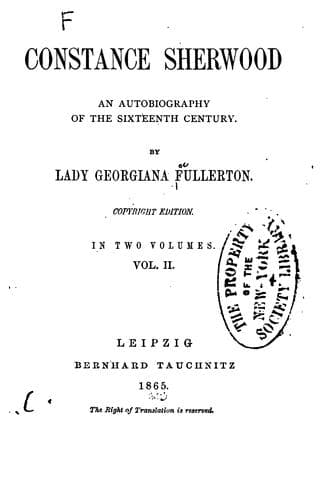
Constance Sherwood: An Autobiography of the Sixteenth CenturyFullerton, Georgiana
History
Constance Sherwood: An Autobiography of the Sixteenth Century
Fullerton, Georgiana
Great Britain -- History -- Elizabeth, 1558-1603 -- Fiction
One of the first persons I saw in London was Hubert Rookwood, who,
when he heard (for being Basil's brother I would not conceal it from
him) that my father was in prison at Bridewell, expressed so much
concern therein and resentment of my grief, that I was thereby moved
to more kindly feelings toward him than I had of late entertained. He
said that in the houses of the law which he frequented he had made
friends which he hoped would intercede in his behalf, and therein
obtain, if not his release, yet so much alleviation of the hardships
of a common prison as should render his condition more tolerable, and
that he would lose no time in seeking to move them thereunto; but that
our chief hope would lie in Sir Francis Walsingham, who, albeit much
opposed to papists, had always showed himself willing to assist his
friends of that way of thinking, and often procured for them some
relief, which indeed none had more experienced than Mr. Congleton
himself. Hubert commended the secrecy which had been observed touching
my father's real name; for if he should be publicly known to be
possessed of lands and related to noble families, it should be harder
for any one to get him released than an obscure person; but
nevertheless he craved license to intimate so much of the truth to Sir
Francis as should appear convenient, for he had always observed that
gentlemen are more compassionate to those of their own rank than to
others of meaner birth. Mr. Congleton prayed him to use his own
discretion therein, and said he should acquaint no one himself of it
except his very good friend the Portuguese ambassador, who, if all
other resources failed, might yet obtain of the queen herself some
mitigation of his sentence. Thereupon followed some days of weary
watching and waiting, in which my only comfort was Mistress Ward, who,
by means of the gaoler's wife, who had obliged her in the like manner
before, did get access from time to time to Mr. Watson, and brought
him necessaries. From him she discovered that the prisoner in the
nearest cell to his own was the so-called Mr. Tunstall, and that by
knocks against the wall, ingeniously numbered so as to express the
letters of the alphabet, as one for _a_, two for _b_, and so to the
end thereof, they did communicate. So she straightway began to
practice this management; but time allowed not of many speeches to
pass between them. Yet in this way he sent me his blessing, and that
he was of very good cheer; but that none should try for to visit him,
for he had only one fear, which was to bring others into trouble; and,
for himself, he was much beholden to her majesty, which had provided
him with a quiet lodging and time to look to his soul's welfare;
which evidence of his cheerful and pious spirit comforted me not a
little. Then that dear friend which had brought me this good comfort
spoke of Mr. Watson, and said she desired to procure his escape from
prison more than that of any other person in the same plight, not
Public-domain text, read in full here on John Shaqi.
Reviews
Reviews
No reviews yet
Be the first to share your thoughts on this work.
Elsewhere in the archive
Join the Discussion
Join the discussion
Sign in to leave a comment or review.
Sign InorCreate an account