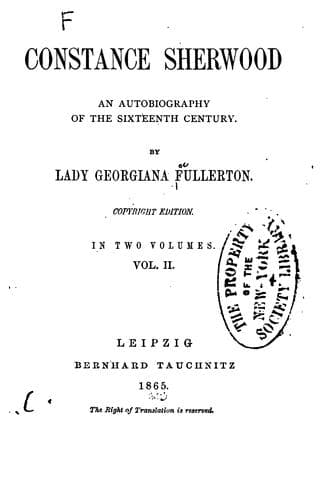
Constance Sherwood: An Autobiography of the Sixteenth CenturyFullerton, Georgiana
History
Constance Sherwood: An Autobiography of the Sixteenth Century
Fullerton, Georgiana
Great Britain -- History -- Elizabeth, 1558-1603 -- Fiction
Then Lady Surrey prayed her not to speak so rashly; but methought in
her heart, and somewhat I could perceive of this in her eyes,
she misliked not wholly this young lady's words, who then spoke of
religion; and oh, how zealous therein she did appear, how boldly
affirmed (craving Lady Surrey's pardon, albeit she would warrant, she
said, there was no need to do so, her ladyship she had heard being
half a papist herself) that she had as lief be racked twenty times
over and die also, or her face to be so disfigured that none should
call her ever after anything but a fright--which martyrdom she held
would exceed any yet thought of--than so much as hold her tongue
concerning her faith, or stay from telling her majesty to her face, if
she should have the chance to get speech with her, that she was a foul
heretic, and some other truths beside, which but once to utter in her
presence, come of it what would, should be a delicious pleasure. Then
she railed at the Catholics which blessed the queen before they
suffered for their religion, proving them wrong with ingenious reasons
and fallacious arguments mixed with pleasantries not wholly becoming
such grave themes. But it should have seemed as reasonable to be angry
with a child babbling at random of life and death in the midst of its
play, as with this creature, the lightest of heart, the fairest in
face, the most winsome in manner, and most careless of danger, that
ever did set sail on life's stream.
Oh, how all this rose before me again, when I heard, two years
afterward, that for her bold recusancy--alas! more bold, as the
sequel proved, than deep, more passionate than fervent--this only
cherished daughter, this innocent maiden, the mirror of whose fame no
breath had sullied, and on whose name no shadow had rested, was torn
by the pursuivants from her parents' home, and cast into a prison with
companions at the very aspect of which virtue did shudder. And the
unvaliant courage, the weak bravery, of this indulged and wayward
young lady had no strength wherewith to resist the surging tides of
adversity. No voice of parent, friend, or ghostly father reached her
in that abode of despair. No visible angel visited her, but a fiend in
human form haunted her dungeon. Liberty and pleasure he offered in
exchange for virtue, honor, and faith. She fell; sudden and great was
that fall.
There is a man the name of which hath blenched the cheeks and riven
the hearts of Catholics, one who hath caused many amongst them to lose
their lands and to part from their homes, to die on gibbets and their
limbs to be torn asunder--one Richard Topcliffe. But, methinks, of all
the voices which shall be raised for to accuse him at Christ's
judgment-seat, the loudest will be Frances Bellamy's. Her ruin was his
work; one of those works which, when a man is dead, do follow him;
whither, God knoweth!
Public-domain text, read in full here on John Shaqi.
Reviews
Reviews
No reviews yet
Be the first to share your thoughts on this work.
Elsewhere in the archive
Join the Discussion
Join the discussion
Sign in to leave a comment or review.
Sign InorCreate an account