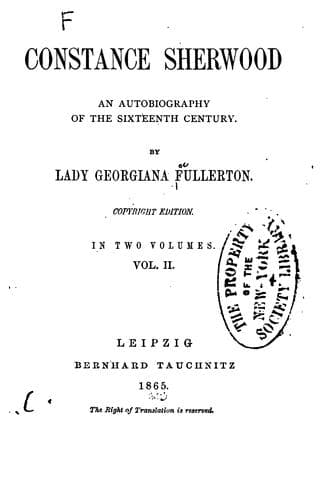
Constance Sherwood: An Autobiography of the Sixteenth CenturyFullerton, Georgiana
History
Constance Sherwood: An Autobiography of the Sixteenth Century
Fullerton, Georgiana
Great Britain -- History -- Elizabeth, 1558-1603 -- Fiction
"There she paused, and clasped her hands together as if scarce able to
proceed; but soon raising her head, she related in a passionate manner
how her heart had then swelled well-nigh to bursting, pride and
tenderness restraining the utterance of such resentful thoughts as
rose in her when she remembered his father's last letter, wherein he
said his chief prop and stay in his fallen estate should be the wife
he had bestowed on him; of her own lands sold for the supply of his
prodigal courtiership; of her long patience and pleading for him to
others; and this his present treatment of her, which no wife could
brook, even if of mean birth and virtue, much loss one his equal in
condition, as well dowered as any in the land, and as faithful
and tender to him as he did prove untoward to her. But none of these
reproaches passed her lips; for it was an impossible thing to her, she
said, to urge her own deserts, or so much as mention the fortune she
had brought him. Only twice she repeated, 'Ruin your fortunes, my
lord! ruin your fortunes! God help me, I had thought rather to mend
them!' And then, when he tried to answer her in some sort of evading
fashion, as if unsaying, and yet not wholly denying his former speech,
she broke forth (and in the relation of this scene the passion of her
grief renewed itself) in vehement adjurations, which seemed somewhat
to move him, not to be so unjust to her or to himself as to leave that
in uncertainty which so nearly touched both their honors; and if the
thought of a mutual love once existing between them, and a firm bond
of marriage relied on with unshaken security, and his father's dying
blessing on it, and the humble duty she had shown him from the time
she had borne his name, sufficed not to resolve him thereunto, yet for
the sake of justice to one fatherless and brotherless as herself, she
charged him without delay to make that clear which, left uncertain,
concerned her more nearly than fortune or state, and without which no,
not one day, would she abide in his house. Then the sweet soul said
she hoped, from his not ungracious silence and the working of his
features, which visibly revealed an inward struggle, that his next
words should have been of comfort to her; but when she had drawn nigh
to him, and, taking his hand, called him by his name with so much of
reproachful endearment as could be expressed in the utterance of it, a
gentleman broke into the room crying out: 'My lord, my lord, the
trumpets do sound! The queen's coach is in sight.' Upon which, she
said that, with a muttered oath, he started up and almost thrust her
from him, saying, 'For God's sake, be gone!' And by a back-door,' she
added, 'I went out of mine own house into the street, where I had left
my Lord Arundel's coach, and crept into it, very faint and giddy, the
while the queen's coach did enter the court with gay banners waving,
and striking-up of music, and the people crying out, "God bless the
Public-domain text, read in full here on John Shaqi.
Reviews
Reviews
No reviews yet
Be the first to share your thoughts on this work.
Elsewhere in the archive
Join the Discussion
Join the discussion
Sign in to leave a comment or review.
Sign InorCreate an account