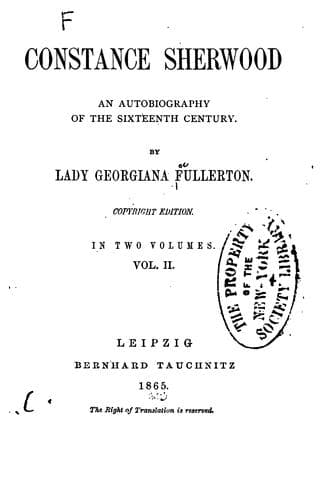
Constance Sherwood: An Autobiography of the Sixteenth CenturyFullerton, Georgiana
History
Constance Sherwood: An Autobiography of the Sixteenth Century
Fullerton, Georgiana
Great Britain -- History -- Elizabeth, 1558-1603 -- Fiction
His manner was so resolved that I urged him no further, and only
heaved a deep sigh. Then he said, kindly: "Come, mine own good child,
give me so much comfort as to let me hear that thou art of the same
way of thinking in this matter as thy unworthy but very resolved
father."
"My dear father," I replied, "methinks I never loved you so well, or
honored you one half so much as now, when you have cast off all human
consolation, yea, and a certain hope of deliverance, rather than give
occasion to the enemies of our faith to boast they had prevailed on
you, in ever so small a matter, to falter in the open profession
thereof; and I pray God, if ever I should be in a like plight, I may
not prove myself to be otherwise than your true child in spirit as in
nature. As to what shall now follow your refusal, it lieth in God's
hands, and I know he can deliver you, if he doth will it, from this
great peril you are in."
"There's my brave wench," quoth he then, laying his scarred hand on my
head; "thy mother had a prophetic spirit, I ween, when she said of
thee when yet a puling girl, 'As her days, so shall her strength be.'
Verily God is very good, who hath granted us these moments of peaceful
converse in a place where we had once little thought for to meet."
As I looked upon him, sitting on a poor bench in that comfortless
cell, his noble fair visage oldened by hardships and toils rather than
years, his eyes so full of peace, yea of contentment, that joy
seemed to beam in them, I thought of the words of Holy Writ, which do
foretell which shall be said hereafter of the just by such as have
afflicted them and taken away their labors: "There are they whom we
had some time in derision and for a parable of reproach. We fools
esteemed their life madness and their end without honor. Behold, how
they are numbered with the children of God, and their lot amongst the
saints."
At that time a knock against the wall was heard, and my father set his
ear against it, counting the number of such knocks; for it was Mr.
Watson, he said, beginning to converse with him in their wonted
fashion. "I will tell him I am engaged," quoth he, in his turn tapping
in the same manner. "But peradventure he hath somewhat to
communicate," I said.
"No," he answered, "for in that case he would have knocked three times
at first, for on this signal we have agreed." Smiling, he added, "We
do confess to each other in this way. 'Tis somewhat tedious, I do
admit; but thanks be to God we lack not leisure here for such duties."
Then I briefly told him of Mistress Ward's intent to procure Mr.
Watson's escape.
"Ay," he said, "I am privy to it, and I do pray God it may succeed. It
should be to me the greatest joy in the world to hear that good man
was set free, or made free by any good means."
"Then," I added, "will you not join in the attempt, if so be she can
convey to you a cord? and the same boat should carry you both off."
Public-domain text, read in full here on John Shaqi.
Reviews
Reviews
No reviews yet
Be the first to share your thoughts on this work.
Elsewhere in the archive
Join the Discussion
Join the discussion
Sign in to leave a comment or review.
Sign InorCreate an account