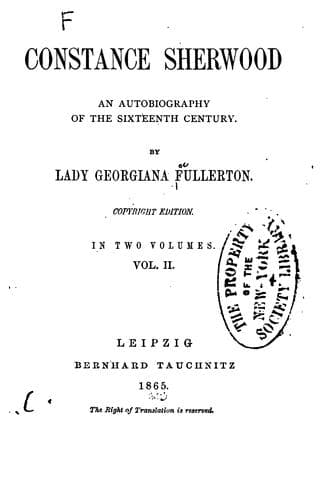
Constance Sherwood: An Autobiography of the Sixteenth CenturyFullerton, Georgiana
History
Constance Sherwood: An Autobiography of the Sixteenth Century
Fullerton, Georgiana
Great Britain -- History -- Elizabeth, 1558-1603 -- Fiction
me so much heartfelt joy and comfort as the new similitude I
experience, and greater I hope to come, to my loved and only Master's
sufferings and death!"
At this time of his recital my tears flowed abundantly; but with an
imparted sweetness, which, like a reflected light, shone from his soul
on mine. But to stay my weeping he changed his tone, and said with
good cheer:
"Come now, my wench, I will presently make thee merry by the recital
of a strait in which I once found myself, and which maketh me to laugh
to think on it, albeit at the time, I warrant thee, it was like to
prove no laughable matter. It happened that year I speak of that I was
once secretly sent for by a courtlike gentleman of good wealth that
had lived in much bravery, and was then sick and lying in great pain.
He had fallen into a vehement agitation and deep study of the life to
come; and thereupon called for a priest--for in mind and opinion he
was Catholic--that he might learn from him to die well. According to
the custom of the Church, I did admonish him, among other things, that
if he had any way hurt or injured any man, or unjustly possessed other
men's goods, he should go about by-and-by to make restitution
according to his ability. He agreed to do so, and called to mind that
he had taken away something from a certain Calvinist, under pretence
of law indeed, but not under any good assurance for a Catholic
conscience to trust to. Therefore, he took order for restitution to be
made, and died. The widow, his wife, was very anxious to accomplish
her husband's will; but being afraid to commit the matter to any one,
her perplexed mind was entangled in briers of doubtfulness. She one
day declared her grief unto me, and beseeched me, for God's sake, to
help her with my counsel and travail. So, seeing her distress, I
proffered to put myself in any peril that might befall in the doing of
this thing; but, indeed, persuaded myself that no man would be so
perverse as of a benefit to desire revengement. Therefore committing
the matter to God, I mounted on horseback, and away I went on my
journey. When I came to the town where the man did dwell to whom the
money was to be delivered, I set up my horse in the next inn, that I
might be readier at hand to scape immediately after my business was
despatched. I then went to the creditor's house, and called the man
forth alone, taking him by the hand and leading him aside from the
company of others. Then I declared to him that I had money for him,
which I would deliver into his hands with this condition, that he
inquired no further either who sent or who brought it unto him, or
what the cause and matter was, but only receive the money and
use it as his own. The old fellow promised fair, and with a good will
gave his word faithfully so to do, and with many thanks sent me away.
With all the speed I was able to make, I hastened to mine host's
house, for to catch hold of my horse and fly away. But forthwith the
Public-domain text, read in full here on John Shaqi.
Reviews
Reviews
No reviews yet
Be the first to share your thoughts on this work.
Elsewhere in the archive
Join the Discussion
Join the discussion
Sign in to leave a comment or review.
Sign InorCreate an account