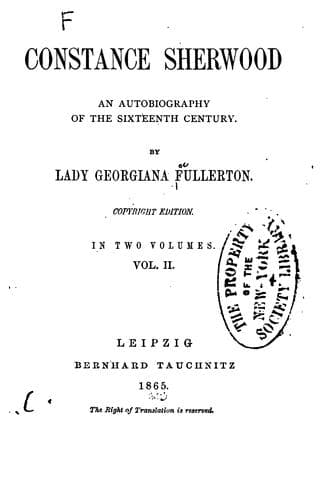
Constance Sherwood: An Autobiography of the Sixteenth CenturyFullerton, Georgiana
History
Constance Sherwood: An Autobiography of the Sixteenth Century
Fullerton, Georgiana
Great Britain -- History -- Elizabeth, 1558-1603 -- Fiction
My first thought, when Muriel had announced to me the coming of the
pursuivants in search of Mistress Ward, was to thank God she was
beyond their reach, and with so much prudence had left us in ignorance
of her abode. Then making haste to dress--for I apprehended these
officers should visit every chamber in the house--I quickly repaired
to my aunt's room, who was persuaded by Muriel that they had sent for
to take an inventory of the furniture, which she said was a very
commendable thing to do, but she wished they had waited until such
time as she had had her breakfast. By an especial mercy, it so
happened that these officers--or, leastways, two out of three of
them--were quiet, well-disposed men, who exercised their office with
as much mildness as could be hoped for, and rather diminished by their
behavior than in any way increased the hardships of this invasion of
domestic privacy. We were all in turns questioned touching Mistress
Ward's abode except my aunt, whose mental infirmity was pleaded for to
exempt her from this ordeal. The one officer who was churlish said,
"If the lady's mind be unsound, 'tis most like she will let the cat
out of the bag," and would have forced questions on her; but the
others forcibly restrained him from it, and likewise from openly
insulting us, when we denied all knowledge of the place she had
resorted to. Howsoever, he vented his displeasure in scornful looks
and cutting speeches. They carried away sundry prayer-books, and
notably the "Spiritual Combat," which Mrs. Engerfield had gifted me
with, when I slept at her house at Northampton, the loss of which
grieved me not a little, but yet not so much as it would have done at
another time, for my thoughts were then wholly set on discovering who
had betrayed Mistress Ward's intervention, and what had been Mr.
Watson's fate, and if Basil also had been implicated. I addressed
myself to the most seemly of the three men, and asked him what her
offence had been.
"She assisted," he answered, "in the escape of a prisoner from
Bridewell."
"In what manner?" I said, with so much of indifferency as I could
assume.
"By the smuggling of a rope into his cell," he answered, "which was
found yet hanging unto his window, and which none other than that
pestilent woman could have furnished him with."
Alas! this was what I feared would happen, when she first formed this
project; but she had assured us Mr. Watson would let himself down,
holding the two ends of the cord in his hands, and so would be enabled
to carry it away with him after he had got down, and so it would never
be discovered by what means he had made his escape.
"And this prisoner hath then escaped?" I said, in a careless manner.
"Marry, out of one cage," he answered; "but I'll warrant you he is by
this time lodged in a more safe dungeon, and with such bracelets on
his hands and feet as shall not suffer him again to cheat the
gallows."
Public-domain text, read in full here on John Shaqi.
Reviews
Reviews
No reviews yet
Be the first to share your thoughts on this work.
Elsewhere in the archive
Join the Discussion
Join the discussion
Sign in to leave a comment or review.
Sign InorCreate an account