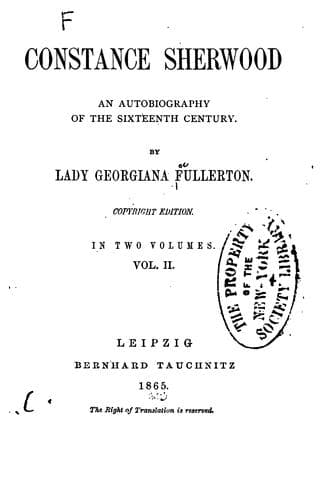
Constance Sherwood: An Autobiography of the Sixteenth CenturyFullerton, Georgiana
History
Constance Sherwood: An Autobiography of the Sixteenth Century
Fullerton, Georgiana
Great Britain -- History -- Elizabeth, 1558-1603 -- Fiction
The housekeeper then came in with bread and meat and beer, which my
dear Basil did very gladly partake of, for he had eat nothing since
the day before, and was greatly in want of food. I waited on him,
forestalling housewifely duties, with so great a contentment in this
quiet hour spent in his company that nothing could surpass it. The
fire now burned brightly; and whilst he ate, we talked of the time
when we should be married and live at Euston, so retired from the busy
world without as should be most safe and peaceful in these troublesome
times, even as in that silent house we were for a short time shut out
from the noisy city, the sounds of which reached without disturbing
us. Oh how welcome was that little interval of peace which we then
enjoyed! I ween we were both very tired; and when the good housekeeper
came in for to fetch away his plate he had fallen asleep, with his
head resting on his hands; and I was likewise dozing in a high-backed
chair opposite to him. The noise she made awoke me, but not him, who
slept most soundly. She smiled, and in a motherly manner moved him to
a more comfortable position, and said she would lay a wager on it he
had not been abed at all that night.
"Well, I'll warrant you to be a good guesser, Mistress Mason," I
answered. "And if you did but know what a hard and a good work he hath
been engaged in, methinks you would never tarry in his praise."
"Ah, Mistress Sherwood," she replied, "I have known Master Basil these
many years; and a more noble, kindly, generous heart never, I ween,
did beat in a man's bosom. He very often came here with his father and
his brother when both were striplings; and Master Hubert was the
sharpest and some said the most well-behaved of the twain. But beshrew
me if I liked not better Master Basil, albeit he was sometimes very
troublesome, but not techey or rude as some boys be. I remember it
well how I laughed one day when these young masters--methinks this
one was no more than five years and the other four--were at play
together in this room, and Basil had a new jerkin on, and colored hose
for the first time. Hubert wore a kirtle, which displeasured him, for
he said folks should take him to be a wench. So he comes to me,
half-crying, and says, 'Why hath Baz that fine new suit and me not the
same?' 'Because, little sir, he is the eldest,' I said. 'Ah,' quoth
the shrewd imp, 'the next time I be born methinketh I will push Baz
aside and be the eldest.' If I should live one hundred years I shall
never forget it, the little urchin looked so resolved and spiteful."
I smiled somewhat sadly, I ween, but with better cheer when she
related how tender a heart Basil had from his infant years toward the
poor, taking off his clothes for to give them to the beggars he met,
and one day, she said, praying very hard Mrs. Wells for to harbor a
strolling man which had complained he had no lodging.
Public-domain text, read in full here on John Shaqi.
Reviews
Reviews
No reviews yet
Be the first to share your thoughts on this work.
Elsewhere in the archive
Join the Discussion
Join the discussion
Sign in to leave a comment or review.
Sign InorCreate an account