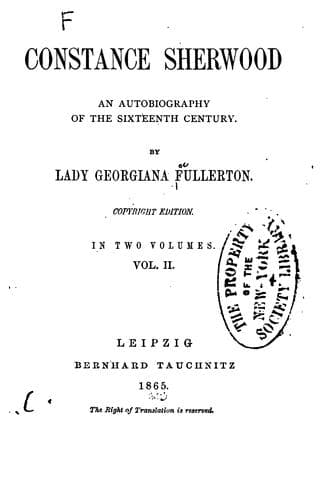
Constance Sherwood: An Autobiography of the Sixteenth CenturyFullerton, Georgiana
History
Constance Sherwood: An Autobiography of the Sixteenth Century
Fullerton, Georgiana
Great Britain -- History -- Elizabeth, 1558-1603 -- Fiction
Polly said--for when had she not, I pray you, somewhat to say?--that
certain things in nature had a propensity to gaiety which naught could
quell, and instanced birds and streamlets, which never cease to sing
and babble as long as they do live or flow. And to be serious, she
thought, would kill her. The while this talk was ministered between
them, my Lady Sydney, on a sign from her father, I ween, took my hand
in hers, and offered to show me the garden; for the heat of the room,
she said, was like to give me the headache. Upon which I rose, and
followed her into a court planted with trees, and then on to an alley
of planes strewed with gravel. As we entered it I perceived several
persons walking toward us. When the first thought came into my mind
who should be the tall personage in the centre, of hair and complexion
fair, and of so stately and majestic deportment, I marvel my limbs
gave not way, but my head swam and a mist obscured mine eyes.
Methinks, as one dreaming, I heard Lady Sydney say, "The queen,
Mistress Sherwood; kneel down, and kiss her majesty's hand." Oh, in
the brief moment of time when my lips pressed that thin, white,
jewelled hand, what multiplied thoughts, resentful memories, trembling
awe, and instinctive, homage to royal greatness, met in my soul, and
worked confusion in my brain!
"Ah, mine own good Sydney," I heard her majesty exclaim; "is this the
young gentlewoman your wise father did speak of at Greenwich
yesterday? The daughter of one Sherwood now in prison for popish
contumacy?"
"Even so," said Lady Sydney; "and your sacred majesty hath it now in
her power to show
"The quality of mercy is not strained--'"
"'But droppeth as the gentle rain from heaven
Upon the place beneath,'"
interrupted the queen, taking the words out of her mouth. "We be not
ignorant of those lines. Will Shakespeare hath it,
'Tis mightiest in the mightiest; it becomes
The throned monarch better than his crown.'
And i' faith we differ not from him, for verily mercy is our habit and
the propension of our soul; but, by God, the malice and ingratitude of
recusant traitors doth so increase, with manifold dangers to our
person and state, that mercy to them doth turn into treason against
ourselves, injury to religion, and an offence to God. Rise," her
majesty then said to me; and as I stood before her, the color, I ween,
deepening in my cheeks, "Thou hast a fair face, wench," she cried;
"and if I remember aright good Mr. Secretary's words, hast used it to
such purpose that a young gentleman we have of late taken into our
favor is somewhat excessive in his doting on it. Go to, go to; thou
couldst go further and fare worse. We ourselves are averse to
marriage; but if a woman must needs have a husband (and that deep
blushing betokeneth methinks thy bent thereon), she should set her
heart wisely, and govern it discreetly."
Public-domain text, read in full here on John Shaqi.
Reviews
Reviews
No reviews yet
Be the first to share your thoughts on this work.
Elsewhere in the archive
Join the Discussion
Join the discussion
Sign in to leave a comment or review.
Sign InorCreate an account