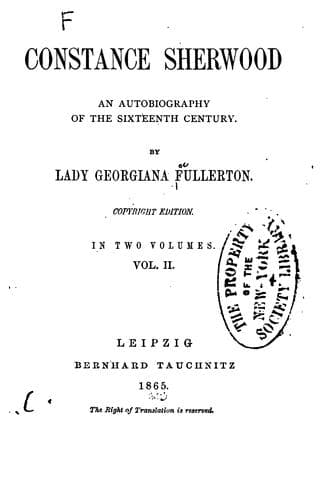
Constance Sherwood: An Autobiography of the Sixteenth CenturyFullerton, Georgiana
History
Constance Sherwood: An Autobiography of the Sixteenth Century
Fullerton, Georgiana
Great Britain -- History -- Elizabeth, 1558-1603 -- Fiction
"What news did you hear, sir, of Mr. Felton?" Mistress Ward asked.
Upon which their countenances fell; and one of them answered that that
gentleman had been racked the day before, but steadily refused, though
in the extremity of torture, to name his accomplices; and would give
her majesty no title but that of the Pretender; which they said was
greatly to be regretted, and what no other Catholic had done. But when
his sentence was read to him, for that he was to die on Friday, he
drew from his finger a ring, which had diamonds in it, and was worth
four hundred pounds, and requested the Earl of Sussex to give it to
the queen, in token that he bore her no ill-will or malice, but rather
the contrary.
Mr. Wells said he was a gentleman of very great heart and noble
disposition, but for his part he would as lief this ring had been
sold, and the money bestowed on the poorer sort of prisoners in
Newgate, than see it grace her majesty's finger; who would thus play
the hangman's part, who inherits the spoils of such as he doth put to
death. But the others affirmed it was done in a Christian manner, and
so greatly to be commended; and that Mr. Felton, albeit he was
somewhat rash in his actions, and by some titled Don Magnifico, by
reason of a certain bravery in his style of dress and fashion of
speaking, which smacked of Monsieur Traveller, was a right worthy
gentleman, and his death a blow to his friends, amongst whom there
were some, nevertheless, to be found who did blame him for the act
which had brought him into trouble. Mistress Ward cried, that such as
fell into trouble, be the cause ever so good, did always find those
who would blame them. Mr. Lacy said, one should not cast himself into
danger wilfully, but when occasion offered take it with patience.
Polly replied, that some were so prudent, occasions never came to
them. And then those two fell to disputing, in a merry but withal
sharp fashion. As he did pick his words, and used new-fangled terms,
and she spoke roundly and to the point, methinks she was the nimblest
in this encounter of wit.
Meanwhile Mr. Wells asked Mr. Congleton if he had had news from the
north, where much blood was spilt since the rising; and he apprehended
that his kinsmen in Richmondshire should suffer under the last orders
sent to Sir George Bowes by my Lord Sussex. But Mr. Congleton did
minister to him this comfort, that if they were noted wealthy, and had
freeholds, it was the queen's special commandment they should not be
executed, but two hundred of the commoner sort to lose their lives in
each town; which was about one to each five.
"But none of note?" quoth Mr. Wells.
"None which can pay the worth of their heads," Mr. Congleton replied.
"And who, then, doth price them?" asked Kate, in a languishing voice.
"Nay, sister," quoth Polly, "I warrant thee they do price themselves;
for he that will not pay well for his head must needs opine he hath a
worthless one."
Public-domain text, read in full here on John Shaqi.
Reviews
Reviews
No reviews yet
Be the first to share your thoughts on this work.
Elsewhere in the archive
Join the Discussion
Join the discussion
Sign in to leave a comment or review.
Sign InorCreate an account