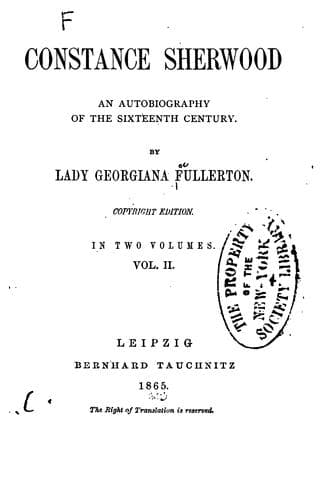
Constance Sherwood: An Autobiography of the Sixteenth CenturyFullerton, Georgiana
History
Constance Sherwood: An Autobiography of the Sixteenth Century
Fullerton, Georgiana
Great Britain -- History -- Elizabeth, 1558-1603 -- Fiction
"Kiss my lips," the sick child softly whispered, as I bent over her
bed. Which when I did, she asked, "What is your name? I mind your
face." When I answered, "Constance Sherwood," she smiled, as if
remembering where we had met. "I heard my grandam calling me last
night," she said; "I be going to her soon." Then a fit of pain came
on, and I had to leave her. She did go from this world a few days
after; and the nurse then told me her last words had been "Jesu!
Mary!"
That day I did converse again alone with my Lady Surrey after dinner,
and walked in the garden; and when we came in, before I left, she gave
me a purse with some gold pieces in it, which the earl her husband
willed to bestow on Catholics in prison for their faith. For she said
he had so tender and compassionate a spirit, that if he did but hear
of one in distress he would never rest until he had relieved him; and
out of the affection he had for Mr. Martin, who was one while his
tutor, he was favorably inclined toward Catholics, albeit himself
resolved to conform to the queen's religion. When Mistress Ward came
for me, the countess would have her shown into her chamber, and would
not be contented without she ordered her coach to carry us back to
Holborn, that we might take with us the clothes and cordials which she
did bestow upon us for our poor clients. She begged Mrs. Ward's
prayers for his grace, that he might soon be set at liberty; for she
said in a pretty manner, "It must needs be that Almighty God takes
most heed of the prayers of such as visit him in his affliction
in the person of poor prisoners; and she hoped one day to be free to
do so herself." Then she questioned of the wants of those Mistress
Ward had at that time knowledge of; and when she heard in what sore
plight they stood, it did move her to so great compassion, that she
declared it would be now one of her chiefest cares and pleasures in
life to provide conveniences for them. And she besought Mistress Ward
to be a good friend to her with mine aunt, and procure her to permit
of my frequent visits to Howard House, as the Charter House is now
often called: which would be the greatest good she could do her; and
that she would be most glad also if she herself would likewise favor
her sometimes with her company; which, "if it be not for mine own
sake, Mistress Ward," she sweetly said, "let it be for his sake who,
in the person of his afflicted priests, doth need assistance."
When we reached home, we hid what we had brought under our mantles,
and then in Mistress Ward's chamber, where Muriel followed us. When
the door was shut we displayed these jewelled stores before her
pleased eyes, which did beam with joy at the sight.
"Ah, Muriel," cried Mistress Ward, "we have found an Esther in a
palace; and I pray to God there may be other such in this town we ken
not of, who in secret do yet bear affection to the ancient faith."
Public-domain text, read in full here on John Shaqi.
Reviews
Reviews
No reviews yet
Be the first to share your thoughts on this work.
Elsewhere in the archive
Join the Discussion
Join the discussion
Sign in to leave a comment or review.
Sign InorCreate an account