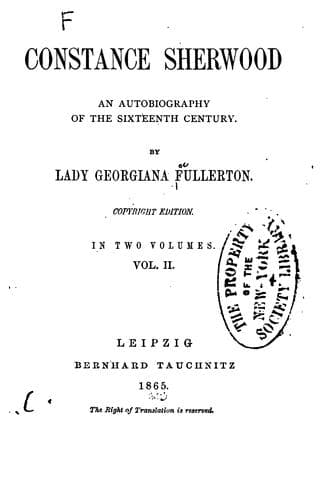
Constance Sherwood: An Autobiography of the Sixteenth CenturyFullerton, Georgiana
History
Constance Sherwood: An Autobiography of the Sixteenth Century
Fullerton, Georgiana
Great Britain -- History -- Elizabeth, 1558-1603 -- Fiction
widow, who, he much feared, would not easily be persuaded to part
from him. Thereupon I expressed a great desire to have a sight of
this youth and charged him to deal with his master so that he should
be sent to my lodgings; which, when he came there, lo and behold, I
perceived with no small amazement that he was no other than Edmund
Genings, who straightway ran into my arms, and with much ado
restrained himself from weeping, so greatly was he moved with
conflicting passions of present joy and recollected sorrow at this
our unlooked-for meeting; and truly mine own contentment therein was
in no wise less than his. He told me that his mother's poverty
increasing, she had moved from Lichfield, where it was more bitter
to her, by reason of the affluence in which she had before lived in
that city, to Stafford, where none did know them; and she dwelt in a
mean lodging in a poor sort of manner. And whereas he had desired to
accept the offer of a stranger, with a view to relieve his mother
from the burden of his support, and maybe yield her some assistance
in her straits, he now passionately coveted to throw his fortune
with mine, and to be entered as a page in my service. But though she
had been willing before, from necessity, albeit averse by
inclination, to part with him, when she knew me it seemed awhile
impossible to gain her consent. Methinks she was privy to Edmund's
secret good opinion of Catholic religion, and feared, if he should
live with me, the effect thereof would follow. But her necessities
were so sharp, and likewise her regrets that he should lack
opportunities for his further advance in learning, which she herself
was unable to supply, that at length by long entreaty he prevailed
on her to give him license for that which his heart did prompt him
to desire for his own sake and hers. And when she had given this
consent, but not before, lest it should appear I did seek to bribe
her by such offers to so much condescension as she then evinced, I
proposed to assist her in any way she wished to the bettering of her
fortunes, and said I would do as much whether she suffered her son
to abide with me or no: which did greatly work with her to conceive
a more favorable opinion of me than she had heretofore held, and to
be contented he should remain in my service, as he himself so
greatly desired. After some further discourse, it was resolved that
I should furnish her with so much money as would pay her debts and
carry her to La Rochelle, where her youngest son was with her
brother, who albeit he had met with great losses, would
nevertheless, she felt assured, assist her in her need. Thus has
Edmund become to me less a page than a pupil, less a servant than a
son. I will keep a watchful eye over his actions, whom I already
perceive to be tractable, capable, willing to learn, and altogether
such as his early years did promise he should be. I thank God, who
Public-domain text, read in full here on John Shaqi.
Reviews
Reviews
No reviews yet
Be the first to share your thoughts on this work.
Elsewhere in the archive
Join the Discussion
Join the discussion
Sign in to leave a comment or review.
Sign InorCreate an account